

Oficina del Presidente @OPRArgentina
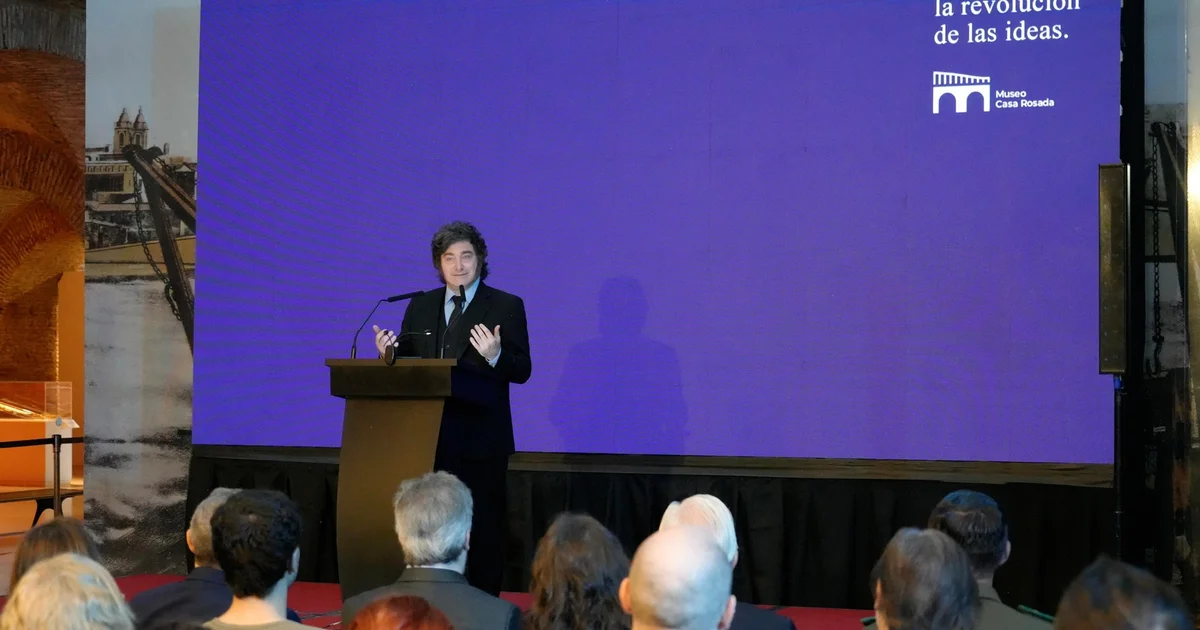
El Presidente Javier Milei encabezó la apertura de la muestra "Belgrano, la revolución de las ideas" en el Museo Casa Rosada, en el marco de La Noche de los Museos 2026.
Three plans: El Resumen Esencial for free, Premium with the full analysis and Intelligence with data and alerts to decide, in English, Spanish or Portuguese.
Three plans: El Resumen Esencial for free, Premium with the full analysis and Intelligence with data and alerts to decide, in English, Spanish or Portuguese.
Three plans: El Resumen Esencial for free, Premium with the full analysis and Intelligence with data and alerts to decide, in English, Spanish or Portuguese.
One topic in one place: the official text, the video, what happened on X, how each outlet told it and the full speech.
🔥 HIGH IMPACT · Full speech · Institutional
At the Casa Rosada exhibit opening, Milei highlighted the opening of over 500 markets and the removal of regulations.
Casa Rosada22 min read
AI estimate · 80% confidence
Main framing
Right 90%
Right · estimated by AI · 80% confidence
The estimate comes from analyzing the story's text: which sources it quotes, which facts it highlights and what language it uses.
An AI model reads the story and estimates how much of its framing leans left, center or toward a libertarian view. The three percentages add up to 100.
This is an AI-generated estimate, not an objective judgment.
Generated on · 1 min read
AI summaries may contain errors.
Milei's speech focuses on celebrating Belgrano's legacy, using language that highlights his historical importance without attacking or defending any contemporary political position.
Copied verbatim from the official speech; translation by +enfoque.
“These ideas were the program that Belgrano developed from the Consulate and from the press for almost two decades.”
— Javier Milei · See it in the speech
“In the face of that moral certainty, doubts are set aside, and great men, like Belgrano, know they must act.”
— Javier Milei · See it in the speech
The official post
El Presidente Javier Milei encabezó la apertura de la muestra "Belgrano, la revolución de las ideas" en el Museo Casa Rosada, en el marco de La Noche de los Museos 2026.
Source: Casa Rosada (CC BY 2.5 AR). Translation by +enfoque
Words of President Javier Milei at the opening of the exhibition 'Belgrano, the Revolution of Ideas' at the Museo Casa Rosada, in the framework of the Night of Museums 2026.
Good afternoon everyone. And beyond that, as a prelude to starting with the speech, probably not everyone knows it, but Diego and I have been friends for a long time and, in fact, we studied together, but it's not that we took classes together; we studied together. And well, he decided more on the side of history; I ended up falling in love with hooks and then with economic growth, but life later united us again. So we are doing things, from my point of view, that are wonderful. And Diego's work, which I had the honor of introducing, is a piece that is worth looking at, reading, because it precisely lifts this liberal position of Manuel Belgrano.
I say, taken from this prelude, we gather today in this Museum of the Casa Rosada, in this building where the Customs used to operate and where the Argentine flag was raised, after the decisive victory in Tucumán on a more than special occasion.
This afternoon we inaugurate an exhibition that proposes an ambitious objective: to recover Manuel Belgrano in all his dimensions. Not only the creator of our national flag nor the General who achieved decisive victories in Tucumán and Salta, but also the intellectual, the economist, the journalist, the educator, the reformer, the revolutionary, and the man of ideas who envisioned a new society before the Argentine Republic existed as we know it.
“This afternoon we inaugurate an exhibit that proposes an ambitious goal: to recover Manuel Belgrano in all his dimensions.”
— Javier Milei
From Plaza de Mayo, his statue looks towards this House. Sarmiento inaugurated it in 1873 and has been watching us for over 150 years. Today I would like us to take this space to reflect on what it means to live up to that gaze.
Belgrano bequeathed to May 1810, not as an amateur nor as a military man of occasion, but after almost 20 years of study. He was the first modern economist of the Río de la Plata and one of the first introducers of liberal ideas in these lands. He did so decades before these ideas were immortalized in our National Constitution, when the word liberal still did not have the political meaning it would acquire later.
Young Belgrano had traveled to Spain to study Law, but in a letter to his mother from Madrid, on February 10, 1790, he expressed that he did not wish to continue dedicating time to what he called 'the subtleties of the Romans'. He preferred to acquire knowledge that he considered more useful and, among them, fundamentally, political economy. At that time, the discipline was still in its infancy, but young Belgrano saw there the seed of the future.
The French Revolution produced in him a true intellectual revolution, as he said in his 1814 autobiography, with a clarity that still moves: the ideas of liberty, equality, security, and property overtook him. He considered plain and simply that those who opposed a man, wherever he was, enjoying certain rights granted to him by God and nature were tyrants. That is to say, Manuel Belgrano was a proponent of the concept of natural rights. What for us is the backbone of Western civilization.
At the young age of 20, thanks to his relentless curiosity, he gained access to authors of the Enlightenment such as Montesquieu, Voltaire, Adam Smith, Jean-Baptiste Say, among others, and from the Italian economist Ferdinando Galiani, for example, he learned that price arises from the utility that people assign to goods and that maximum prices set by the state create scarcity and disorder.
Belgrano read 'The Wealth of Nations', a fundamental work that this year marks its 250th anniversary, and the work of the physiocrat Quesnay. And he not only read them: he discussed them, donated them, and circulated them. Many of those books that we can reconstruct in this exhibition were part of his library and the libraries he helped enrich.
It is worth highlighting that Belgrano was the son of a merchant who prospered within the Spanish monopolistic system, but despite having been born with that privilege, he knew the injustice that that model implied and thus fought against the monopoly throughout his life.
In 1794 he took office as the Permanent Secretary of the Consulate of Buenos Aires, a position he held until April 1810, and during those 16 years he wrote his famous annual memoirs.
In 1796 he drafted the memo titled 'General Means to Promote Agriculture, Encourage Industry and Protect Commerce in an Agricultural Country', a document preserved in the National General Archive and which constitutes one of the central elements of this exhibition. The very title was already a program: promote agriculture, encourage industry, protect commerce.
Belgrano understood that wealth did not come from the privileges of power nor from the accumulation of metals, but from work, production, and exchange. This was the idea that motivated Adam Smith and that changed the history of our young nation forever.
Each phrase an outlet attributes to Milei, searched in the published official text (in Spanish). Automatic comparison, no AI; the official version may edit the spoken speech.
«se propone un ambicioso objetivo: recuperar a Manuel Belgrano en toda su dimensión»
Página/12✓ Appears word for word in the official version
«vamos a seguir bajando impuestos y, en todo el período, de cumplirse el escenario base, le vamos a devolver a los argentinos 500 mil millones de dólares. Es decir, lo que tenemos de deuda»
Página/12≈ Appears, with minor differences
The colonies at that time did not have the capital accumulated from centuries of history that the great European metropolises had, and they also had very little population density. Therefore, the fundamental instrument for them to be free and independent was precisely the freedom they could exercise within themselves. And for that, he maintained that those who excelled in those examinations should be rewarded, because merit, and not favor, is the engine of a society's progress.
He was well aware that when politics paves the way for excellence, instead of stifling it to preserve its position, society can advance. He was editor of the 'Correo de Comercio' and participated in the circles that gave life to the 'Telégrafo Mercantil' and to the weekly publication 'Agriculture, Industry, and Commerce'.
He also wanted to speak to the farmers, to those who produced and worked. In those writings, he left phrases that this exhibition rightly highlights and that, to this day, it is necessary to repeat them. For example: 'No thing has a real value in itself, but the one we want to give it, and this is linked to need, desires, its scarcity, and abundance.' That is to say, Belgrano understood perfectly that value is subjective and is subject to the laws of supply and demand, something that many, over 200 years later, still do not understand.
I will make a small detour from the speech because there are so many elements here, I would say superlatives, this view of the subjective theory of value, I say this comes from having been in Salamanca, because basically the scholastics, who are actually the true creators of liberalism, that is to say, liberalism was born in Spain, with the scholastics. And this is not a minor topic. The sources that Belgrano worked on... God, if someone had to criticize anything about Adam Smith's work, the only thing they could criticize is having used an incorrect theory of value, that is to say, they do my job with the labor theory of value.
The consequences of that error were severe, so to speak, because that allowed Ricardo to get involved with distributive issues and that was the foundation of Rodbertus' theory of exploitation and from there Marx derived surplus value. That is to say that the problem with the construction of the theory of value brought consequences not only negative in terms of the history of economic thought but truly lamentable for humanity because against the backdrop of misery there were also 150 million human beings murdered.
I say, but there is another part, of Adam Smith's work that is wonderful, and this is why it seems so important to highlight it to me. By the way, I am a fervent defender of Adam Smith. Basically, Adam Smith, when he publishes the 'Investigation into the Nature and Causes of the Wealth of Nations', if you look at it, the economy did not exist as a field at that moment, but was instead a part of the course he taught on Moral Philosophy.
And basically, what Adam Smith describes is a model of economic growth. This is not minor. Yes? Why? Because these are the ideas that Belgrano promoted. That is to say, Belgrano is a proponent of economic growth. Basically, Belgrano, by taking Adam Smith, adopts a model that explains economic growth. When you take the history of per capita GDP from the Christian era, which is a work by an economist named Angus Maddison, may he rest in peace, we have created a field called millennial macroeconomics, and what you see is that the per capita GDP remains practically constant from the year zero of the Christian era until 1800 and then it takes off.
And, from there, per capita GDP in a world where the population multiplies by 10 multiplies GDP by 150, that is to say 15 times the per capita product. And that implied that poverty levels in the world shifted from 95% to measures that need to be changed recurrently to have an idea of poverty, because otherwise, the number would be losing its meaning. And that is more: if you had had, in the year 1800, an econometrician and had done econometrics, he would have said that what Adam Smith proposed was nonsense. That is why Malthus develops the idea of diminishing marginal returns. That is to say, there the dispute is born between the techno-optimists, Adam Smith, and the techno-pessimists, the heirs of Malthus.
I will give a note of color about Adam Smith that you probably do not know, because Adam Smith saw it coming. That is to say, with the idea of the pin factory, right?, that one person alone can basically produce 20 pins in a day and that, if divided into 10 tasks, productivity jumps 240 times. So, what happens? That generates that you put an input into production, it grows more than proportionally. And that is the basis of economic growth. So, what Adam Smith explained is that the division of labor generates this increase in productivity, that is, economic growth.
In addition, he had also discovered other sources of economic growth. One was learning by doing: he said that as I do the activity more times, I do it better. That is, practice learning. And not only that, another fundamental idea was technological progress. He said that, at some point, they discover some way to do the same thing with much less work. In other words, he discovers technological progress.
And another fundamental idea as well, which erases all the dystopian scenarios, so to speak, today very much discussed, for example, regarding artificial intelligence, which is nothing more than the pin factory of the 21st century. Why? Because it did the division of labor. If you want, growing returns, if you want, economic growth is limited by the size of the market. That is to say, all dystopian scenarios fade away because, at the end of the day, someone will have to sell that. That is to say, the size of the market.
That is to say, see that then the work of Adam Smith is fabulous because, in addition, he anticipated 200 years ahead of his peers. I say, because we only discovered endogenous growth and beyond in the year, to be exact, 1983, with Paul Romer's doctoral thesis at the University of Chicago, tutored by Robert Lucas Junior. That is to say, what does this mean? That Belgrano had embraced the ideas that brought progress, but, in addition, had given it an upgrade because he worked with the subjective theory of value. I say, this is not minor because I tell you that the subjective theory of value in economic theory appears with Menger in 1871.
Come on, now do you realize the value of all this? That is to say, just as Adam Smith saw it first, Belgrano also made the upgrade that solved the problem. I'm saying this because, precisely, one of the things that economic growth models had until now, and I'm going to explain why problems, was that all these models, which had increasing returns and explain how the economy has expanded over the last 250 years, have a problem which is a joke we used to make among economists: trees don’t grow to the sky. In other words, the models tended to put patches so that, precisely, trees wouldn’t grow to the sky.
Well, why do I say all this in the past? Because this year, with Doctor Demian Reidel, we presented a paper where we demonstrated that you can have increasing returns, generate endogenous growth, and trees don’t grow to the sky because, basically, every time you put an additional unit of labor, yes, it’s true that you gain productivity more than disproportionately, but that additional unit of labor means you’re losing leisure, and each unit of leisure you lose becomes increasingly costly. So, every time you gain an additional unit of production, your satisfaction increases, but less than proportionately.
And you are in the middle of the Sahara desert, at 40 degrees, you are cooking alive. I mean, how much do you pay for the first bottle of water? A lot. For the second, less; for the third, less. After you drink 20 liters and if they bring you a bottle of water, you throw it over your head. That is, the utility derived from consumption grows, but decreasingly. But as you start giving up leisure in the form of work, leisure becomes more valuable.
Your leisure when you are unemployed becomes so abundant that it becomes a problem. As you start working and applying hours, leisure starts to become more valuable. If you had to work 23 hours, you would have a problem, to put it one way, because you would only have one hour left to eat, sleep, and so on; you can’t. The cost tends to infinity. So much so that if I tell you: I’m going to give you a job where I’ll pay you 60 million dollars a year, everyone is surely going to say: “yes, delighted.”
Well, that job you will only be able to collect when the calendar year is up, and you will have to work 24 hours a day. Would you accept it? You can’t, you can’t.
That shows that every time you give up a unit of leisure and leisure becomes more valuable than proportionately, it is the counterpart, let’s say, of decreasing marginal utility in consumption. Therefore, when you add one more unit of labor, you will have more production, but that value in consumption decreases every time and the cost increases every time. At some point, those two things match and the model closes. Well, that’s what we did with Doctor Reider.
This allows you to have increasing returns, have growth, and besides having growth, trees don’t reach the sky. So, we made an improvement on Adam Smith, but it seems that the improvement was already in Belgrano. This is interesting. That is why I find it extremely important. And, moreover, the issue of competition; notice that few people lived here and, how did I achieve concurrency? By opening up the economy. Protecting trade allows competition to exist.
So what we are doing today, the three pillars of growth are: deregulation to boost increasing returns, opening up the economy, and human capital. It was all already written; the only thing we had to do was follow the steps laid out by our first economist, Manuel Belgrano. Returning now to the formal part.
He also asserted that this country without trade would be a miserable and unfortunate country. And boy have we experienced misery and misfortune when we turned our backs on trade. That is why we have decided, from our Government, to resume that path that our founding father had already marked for us in his writings. That is, Belgrano understood that the fate of the country was intrinsically linked to its participation in global trade. An Argentina trapped in itself was even then a tempting dream, but one that led to failure. History only proved him right.
“He also affirmed that this country without trade would be a miserable and unhappy country.”
— Javier Milei
In fact, in the 100 years prior to our coming to Government, what Argentina did was close itself off more and more and we became poorer and poorer. In fact, notice that closing off the economy and shrinking the market size, whether 48 million, 50 million, does nothing but put a brake on economic growth. Why? Because it obstructs the division of labor.
When we arrived, we only traded with 10% of the countries on the planet. Today we have opened up more than 500 markets and we trade with 30% of the planet. We have signed the agreement with the European Union. Let’s say, we signed EFTA, we have an agreement with Singapore, an agreement with the United States, we are entering the Trans-Pacific. We are already at 30% and our goal is to reach, by the year 2031, for those who doubt that I am running for re-election: yes, I am running for re-election. And the goal is to reach 2031 to trade with 90% of the planet.
And not only that, we will continue to lower taxes and, throughout the period, if the base scenario is fulfilled, we will return 500 billion dollars to Argentines, that is, what we have in debt. So just think about how much we have to do to make Argentina great again.
Moreover, Belgrano was also a critic of the prices set by the authority, which at that time were supervised by a representative of the Crown called the “faithful executor.” He then argued that there is no “faithful executor” or maximum price better than competition, which he referred to as “concurrence”; this was, in his words, the only judge capable of balancing prices according to need, abundance, and scarcity. It’s a work of art the phrase; Menger wasn’t even around yet, it’s extraordinary, but the beauty of the phrase is incredible. Sorry for getting emotional, but the beauty of the phrases is incredible.
Look, I’m going to talk about two examples. Everyone is surprised by the effect we are having in the energy sector. The progress we are making is impressive. We have turned the trade balance around at current prices, by about 30 billion dollars, because we should be in a deficit of 15,000 and we are in a surplus of 15,000. This, I mean, explains a reversal of 30 billion dollars. Well, I say, this is the result of one of the 18,000 deregulations that Federico Sturzenegger made, which was to eliminate the criollo barrel, that is, to eliminate a maximum price. That’s 30,000 greenbacks; I mean, it slightly changed the exchange market with those things.
But not only that; let’s say, if I take the case of a law, the modification of the Glacier Law; I mean, Argentina exported 3 billion dollars in mining; Chile, with the same mountain range, exports 60 billion dollars. That is why, let’s say, that change that seems minor will multiply our mineral exports by 20.
In fact, in very few years, the energy sector will have a surplus of 50 billion dollars in the base scenario. I mean, look, I’m talking about having touched just two little things; imagine if we touch 18,000, everything that is underground surfacing in Argentina.
In fact, it is so strong that, when you look at all the processes of deep structural reforms, GDP always falls at first... I give two emblematic cases: Estonia fell 20% of GDP in the first year, or the case of Poland which did it more gradually, fell 10% in 4 years. Well, we, in the first 30 months, GDP measured by EMAE, in the monthly seasonally adjusted frequency, to avoid paying the costs, let’s say, of the statistical drag that the previous government left and truly measure the impact of what we did, GDP is up 11%.
That is, look at everything that is happening underneath, that something that would have generated drops of between 10 and 20%, I mean, aside from having avoided the crisis, right?, that alone would have already caused a drop of 15 and a hyper and 90 percent of the poor, and we are also making the economy grow. I mean, that is why the issue of ideas is so important.
And another case of maximum price: we eliminated the Rent Law, supply quadrupled and the price fell almost 40% in real terms. Come on, we are a beautiful laboratory in terms of magnificent results. I mean, if I had to propose a program, I would say: “Let’s do Belgrano,” that will make us great again.
Moreover, Belgrano warned that maximum prices destroy the seller’s property over the fruit of their labor because it subjects them to someone else’s whim and not to the fair estimation provided by competition. And he added a truth that remains contemporary: man only works in those branches where he sees utility, and if this is denied or limited, the incentive of property and industry is destroyed.
“Not by having a comfortable price in the cities,” he said, “should the laborer be subjected to selling at a certain price.” He added, moreover, that “the laborer should not be forced to sell at a certain price set by a man without intelligence or knowledge of the expenses, care, and work of cultivation.” I mean, what he was clear about was what I say, that it was the Edict of Diocletian. He was clear that Rome was the first victim of populism. I mean, someone so educated understood the disasters that this caused.
That is, you couldn’t exploit the countryside to gain political favor in the cities because it was a perfect recipe for destroying production. He knew that when you suffocate the countryside, sooner or later, all industry and commerce also resist and stagnate. In fact, I have an article called “Rome, the first victim of populism,” about how all the bread and circus ended up collapsing Rome. That’s it.
These ideas were the program that Belgrano developed from the Consulate and from the press for nearly two decades, because before making the political revolution, Belgrano had already thought of a new society, a society founded on economic freedom, property, competition, education, and merit, and the future of the country through freedom and he carried forward what he believed in.
That is why, when May arrived, those ideas had already prepared the ground. The flag he raised in Rosario was both a military symbol as well as the visible expression of a deeper cause: the cause of a people who had the right to govern themselves and build their prosperity on the basis of free work and voluntary exchange, not on the monopolies and privileges of the Old Regime.
On February 26, 1812, he wrote to the nascent government to ask it to abandon the flag of the Spanish Empire because it seemed that the chains of slavery had not yet been broken. The next day, in Rosario, he raised the flag without asking for permission because in history, the conscience of freedom demands action. In the face of that moral certainty, doubts are set aside, and great men like Belgrano know they must act.
Today, in this museum, at the foot of the documents, the newspaper headlines, the memoirs, and the phrases that Belgrano wrote, we recover that full dimension. We recover the man who, long before 1810, was already fighting against mercantilism, monopolies, and the arbitrariness of prices set by power.
We have recovered the intellectual who understood that, without free trade, without property, and without competition, this country would be miserable and wretched. We have recovered the hardened patriot who, guided by this vision of a new world, set aside calculations and risked his life for his ideas. And above all, we have recovered the conviction that the ideas of freedom, equality, security, and property are the very foundations of the republic that he helped to found, which led it, half a century later, to an unimaginable prosperity at that time.
That is why, just as we learn from the words of Belgrano; we must also learn from the history of mistakes of our common past, and use them as fuel for a renewed faith and inspiration in the men who gave their lives to make ours a free and independent nation.
And that is why we want this exhibition to serve as a way for Argentines to once again look at Belgrano head-on, in all his stature, and remember how the unconditional commitment to freedom was what once made us great, and this will ensure that Argentina is great again.
In this sense, I want to acknowledge those who made this exhibition possible: the staff of the Casa Rosada Museum, the researchers, archivists, restorers, curators, and designers who recovered and valued each document, each page, and each object that we can see today. Their patient and rigorous work allows us to look at Belgrano with the same clarity with which he looked at his time. To all of them, thank you very much.
May God bless the Argentines, may the forces of heaven accompany us, and ¡viva la Patria!
Palabras del Presidente Javier Milei en la apertura de la muestra “Belgrano, la revolución de las ideas” en el Museo Casa Rosada, en el marco de Noche de los Museos 2026
Buenas tardes a todos. Y más allá de eso, como previo a arrancar con el discurso, probablemente no lo sepan todos, pero con Diego somos amigos desde hace mucho tiempo y, de hecho, estudiamos juntos, pero no es que cursamos juntos, además estudiábamos juntos. Y bueno, él decidió más desde el lado de la historia; yo me terminé enamorando de los ganchos y después del crecimiento económico, pero la vida después nos unió nuevamente. Así es que estamos haciendo cosas, desde mi punto de vista, que son maravillosas. Y el trabajo de Diego, que tuve el honor de prologar, es una obra que vale la pena mirar, leer, porque justamente levanta esta posición liberal de Manuel Belgrano.
Digo, sacado de esta previa, nos reunimos hoy en este Museo de la Casa Rosada, en este edificio donde supo funcionar la Aduana y donde se izó la bandera argentina, tras la decisiva victoria en Tucumán en una ocasión más que especial.
Esta tarde inauguramos una muestra que se propone un ambicioso objetivo: recuperar a Manuel Belgrano en toda su dimensión. No solamente al creador de nuestra bandera nacional ni al General que supo obtener conquistas determinantes en Tucumán y Salta, sino también al intelectual, al economista, al periodista, al educador, al reformista, al revolucionario y al hombre de ideas que pensó una sociedad nueva antes de que existiera la República Argentina como la conocemos.
Desde Plaza de Mayo, su estatua mira hacia esta Casa. Sarmiento la inauguró en 1873 y hace más de 150 años que nos observa. Hoy me gustaría que nos tomemos de este espacio para reflexionar sobre qué implica estar a la altura de esa mirada.
Belgrano nos legó a mayo de 1810, no como un improvisado ni como un militar de ocasión, sino después de casi 20 años de estudio. Fue el primer economista moderno del Río de la Plata y uno de los primeros introductores de las ideas liberales en estas tierras. Y lo hizo décadas antes de que estas ideas fueron inmortalizadas en nuestra Constitución Nacional, cuando la palabra liberal todavía no tenía el sentido político que adquiere más tarde.
El joven Belgrano había viajado a España para estudiar Derecho, pero en una carta a su madre desde Madrid, el 10 de febrero de 1790, manifestó no querer continuar dedicando tiempo a lo que llamaba “las sutilezas de los romanos”. Prefería adquirir conocimientos que consideraba más útiles y, entre ellos, fundamentalmente, la economía política. En ese entonces, la disciplina estaba aún en su infancia, pero el joven Belgrano vio allí la semilla del futuro.
La Revolución Francesa produjo en él una verdadera revolución intelectual, tal como dijo en su autobiografía de 1814, con una claridad que todavía conmueve: las ideas de la libertad, igualdad, seguridad y propiedad se apoderaron de él. Consideraba lisa y llanamente tiranos a quienes se oponían a que el hombre, donde quiera que estuviese, disfrutara de ciertos derechos que Dios y la naturaleza le habían concedido. Es decir, Manuel Belgrano era un impulsor del concepto del derecho natural. Lo que para nosotros es la columna vertebral de la civilización occidental.
A la joven edad de 20 años, gracias a su implacable curiosidad, logró acceder a autores de la Ilustración como Montesquieu, Voltaire, Adam Smith, Jean-Baptiste Say, entre otros, y del economista italiano Ferdinando Galiani, por ejemplo, aprendió que el precio nace de la utilidad que las personas le asignan a los bienes y que los precios máximos fijados por el Estado generan escasez y desorden.
Belgrano leyó «La riqueza de las naciones», obra fundamental que este año transita su aniversario número 250, y la obra del fisiócrata Quesnay. Y no solo los leyó: los discutió, los donó y los puso a circular. Muchos de esos libros que hoy podemos reconstruir en esta muestra formaron parte de su biblioteca y de las bibliotecas que ayudó a enriquecer.
Vale destacar que Belgrano fue hijo de un comerciante que prosperó dentro del sistema monopólico español, pero, a pesar de haber nacido con ese privilegio, sabía la injusticia que implicaba ese modelo y por eso combatió el monopolio durante toda su vida.
En 1794 asumió como Secretario Perpetuo del Consulado de Buenos Aires, cargo que ocupó hasta abril de 1810, y en esos 16 años escribió sus célebres memorias anuales.
En 1796 redactó la memoria titulada “Medios generales de fomentar la agricultura, animar la industria y proteger el comercio en un país agricultor”, documento que se conserva en el Archivo General de la Nación y que constituye uno de los elementos centrales de esta muestra. El propio título era ya un programa: fomentar la agricultura, animar la industria, proteger el comercio.
Belgrano entendía que la riqueza no provenía de los privilegios del poder ni de la acumulación de metales, sino del trabajo, de la producción y del intercambio. Esta fue la idea que animó a Adam Smith y que cambió para siempre la historia de nuestra joven nación.
Las colonias en aquel entonces no tenían el capital acumulado de siglos de historia que tenían las grandes metrópolis europeas y tenían tan poco la densidad poblacional. Por eso, el instrumento fundamental para que ellas pudieran ser libres e independientes era precisamente la libertad que podían hacer en su seno. Y para eso sostenía que hay que premiar a quienes sobresalgan esos exámenes, porque el mérito y no el favor es el motor del progreso de una sociedad.
Tenía bien en claro que cuando la política le abre paso a la excelencia, en lugar de sofocarla para preservar su posición, la sociedad puede avanzar. Fue editor del Correo de Comercio y participó de los círculos que dieron vida al Telégrafo Mercantil y a la publicación semanal de Agricultura, Industria y Comercio.
Él quería hablarles también a los labradores, a quienes producían y trabajaban. En aquellos escritos dejó frases que esta muestra pone en relieve con toda justicia y que, hasta el día de hoy, es necesario repetirlas. Por ejemplo: «Ninguna cosa tiene un valor real en sí misma, sino el que nosotros le queremos dar, y este se liga a la necesidad, deseos, a su escasez y abundancia». Es decir, Belgrano entendía perfectamente que el valor es subjetivo y está sujeto a las leyes de oferta y demanda, algo que muchos, a más de 200 años, siguen sin entender.
Voy a hacer un pequeño desvío del discurso porque acá hay muchos elementos, les diría que superlativos, esta visión de la teoría subjetiva del valor, digo esto deriva de haber estado en Salamanca, porque básicamente los escolásticos, que son en realidad los verdaderos creadores del liberalismo, o sea, el liberalismo nació en España, con los escolásticos. Y esto no es un tema menor. Las fuentes sobre las que trabaja Belgrano... Dios, si alguien tuviera que recriminar algo de la obra de Adam Smith, lo único que podría recriminarle es haber utilizado una incorrecta teoría del valor, es decir, hagan mi trabajo con la teoría valor-trabajo.
Eso, las consecuencias de ese error fueron graves, por decirlo de alguna manera, porque eso permitió a Ricardo meterse con las cuestiones distributivas y eso fue el fundamento de la teoría de la explotación de Rodbertus y de ahí Marx sacó la plusvalía. Es decir que el problema con la construcción de la teoría del valor trajo consecuencias no sólo negativas en términos de historia del pensamiento económico, sino verdaderamente lamentables para la humanidad, porque a contracara de la miseria además fueron 150 millones de seres humanos asesinados.
Digo, pero hay otra parte, de la obra de Adam Smith que es maravillosa, y es que, y esto es por eso que me parece a mí tan importante resaltarlo. Además, yo soy un ferviente defensor de Adam Smith. Básicamente, Adam Smith, cuando publica la investigación sobre la naturaleza y causas de la riqueza de las naciones, si ustedes se fijan, digamos, lo que está en ese momento es que la economía no existía como campo, sino que era una parte del curso que daba de Filosofía Moral, que daba Adam Smith.
Y, básicamente, lo que describe Adam Smith es un modelo de crecimiento económico. Esto no es menor. ¿Sí? ¿Por qué? Porque estas son las ideas que impulsaba Belgrano. Es decir, Belgrano es un impulsor del crecimiento económico. Básicamente, Belgrano, al tomar a Adam Smith, toma un modelo que explica el crecimiento económico. Cuando ustedes toman la historia del PBI per cápita desde la era cristiana, que es un trabajo de un economista que se llama Angus Maddison, que en paz descanse, hemos creado un campo que se llama macroeconomía milenaria, y ustedes lo que ven es que el PBI per cápita permanece prácticamente constante desde el año cero de la era cristiana hasta el 1800 y después despega.
Y, a partir de ahí el PBI per cápita en un mundo donde multiplica por 10 la población, multiplica el PBI por 150, es decir que subió 15 veces el producto per cápita. Y eso implicó que los niveles de pobreza en el mundo pasaran del 95% a medidas que hay que cambiar recurrentemente para poder tener una idea de pobreza, porque, si no, ya el número estaría perdiendo sentido. Y eso, es más: si ustedes hubieran tenido, en el año 1800, un econometrista y hubiera hecho la econometría, hubiera dicho que era un disparate lo que planteaba Adam Smith. Por eso Malthus desarrolla la idea de los rendimientos marginales decrecientes. Es decir, ahí nace la disputa entre los tecno optimistas, Adam Smith, y los tecno pesimistas, los herederos de Malthus.
Voy a dar una nota de color sobre Adam Smith que probablemente no la conozcan, porque Adam Smith la vio venir. Es decir, con la idea de la fábrica de alfileres, ¿no?, que una persona sola puede producir básicamente 20 alfileres en un día y que, si se divide en 10 tareas, la productividad salta 240 veces. Entonces, ¿qué es lo que ocurre? Eso, lo que genera es que ustedes ponen un insumo en la producción, crece más que proporcionalmente. Y esa es la base del crecimiento económico. Entonces, lo que explicaba Adam Smith era que la división del trabajo genera este aumento de la productividad, o sea, crecimiento económico.
Además, ya había descubierto también otras fuentes de crecimiento económico. Una era el learning by doing: decía que, en la medida en que yo voy haciendo más veces la actividad, la hago mejor. Es decir, aprendizaje en la práctica. Y no solo eso, otra idea fundamental era el progreso tecnológico. Decía que, en algún momento, descubren alguna forma de hacer lo mismo con mucho menos trabajo. O sea, descubre el progreso tecnológico.
Y otra idea fundamental también, que es algo que desecha todos los escenarios distópicos, digamos, hoy muy discutidos, por ejemplo, respecto a la inteligencia artificial, que no es ni más ni menos que la fábrica de alfileres del siglo XXI. ¿Por qué? Porque hizo la división del trabajo. Si ustedes quieren, los rendimientos crecientes, si ustedes quieren, el crecimiento económico está limitado por el tamaño del mercado. Es decir, todos los escenarios distópicos se desvanecen porque, en el fondo, a alguien le van a tener que vender eso. Es decir, el tamaño del mercado.
Es decir, vean que, entonces, la obra de Adam Smith es fabulosa porque, además, se anticipó 200 años a sus pares. Digo, porque recién descubrimos el crecimiento endógeno y demás allá en el año, para ser exacto, en 1983, con la tesis doctoral de Paul Romer en la Universidad de Chicago, tutorado por Robert Lucas Junior. Es decir, ¿qué significa esto? Que Belgrano había abrazado las ideas que traían el progreso, pero, además, le había dado un upgrade, porque trabajaba con la teoría subjetiva del valor. Digo, esto no es menor porque les cuento que la teoría subjetiva del valor en la teoría económica aparece con Menger en el año 1871.
Vamos, ¿ahora se dan cuenta del valor que tiene todo esto? Es decir, así como Adam Smith la vio primero, Belgrano también le metió el upgrade que cerraba el problema. Lo digo porque, justamente, una de las cosas que tenían hasta ahora los modelos de crecimiento económico, y ahora voy a explicar por qué problemas, era que todos estos modelos, que tenían rendimientos crecientes y permiten explicar cómo se ha expandido la economía en los últimos 250 años, tienen un problema que es un chiste que nos hacíamos entre los economistas: los árboles no crecen hasta el cielo. Es decir, los modelos les solían poner parches para, justamente, que los árboles no crezcan hasta el cielo.
Bueno, ¿por qué lo digo todo en pasado? Porque este año, con el Doctor Demian Reidel, presentamos un trabajo donde demostramos que ustedes pueden tener rendimientos crecientes, generar crecimiento endógeno y los árboles no crecen hasta el cielo porque, básicamente, cada vez que ustedes ponen una unidad adicional de trabajo, sí, es cierto que ganan productividad más que proporcionalmente, pero esa unidad de trabajo que ustedes ponen adicional implica que están perdiendo ocio, y cada unidad de ocio que van perdiendo es cada vez más costosa. Entonces, cada vez que ustedes ganan una unidad adicional de producción, su satisfacción aumenta, pero menos que proporcionalmente.
Y ustedes están en el medio del desierto del Sahara, a 40 grados, están cocinando vivos. Digo, ¿cuánto pagan por la primera botella de agua? Un montón. Por la segunda, menos; por la tercera, menos. Después de que tomaron 20 litros y si les traen una botella de agua, se la tiran por la cabeza. Es decir, que la utilidad derivada del consumo crece, pero decrecientemente. Pero, en la medida que ustedes van entregando ocio en formato del trabajo, cada vez se hace más valioso el ocio.
El ocio de ustedes cuando están sin trabajo, se vuelve tan abundante que pasa a ser un problema. En la medida en que ustedes van trabajando y van aplicando horas el ocio empieza a ser más valioso. Si ustedes tendrían que trabajar 23 horas tendrían un problema, por decirlo de alguna manera, porque les quedaría solamente una hora para comer, dormir y demás, no pueden. Ahí va tendiendo a infinito el costo. A punto tal que si yo les digo: les voy a dar trabajo en el cual les voy a pagar 60 millones de dólares al año y todos seguramente van a decir: “si, encantado”.
Bueno, ese trabajo solamente lo van a poder cobrar cuando se cumpla el año calendario y van a tener que trabajar 24 horas por día. ¿Lo aceptarían? No pueden, no pueden.
Es decir, eso muestra que cada vez que van entregando una unidad de ocio y el ocio va valiendo más que proporcionalmente, es la contracara, digamos, de la utilidad marginal decreciente en el consumo. Por lo tanto, cuando meten una unidad más de trabajo, van a tener más producción, pero ese valor en consumo es cada vez menor y el costo es cada vez mayor. En algún momento, esas dos cosas se empatan y el modelo queda cerrado. Bueno, eso es lo que hicimos con el Doctor Reider.
Eso hace que ustedes puedan tener rendimientos crecientes, puedan tener crecimiento y, además de tener crecimiento, los árboles no llegan hasta el cielo. O sea, hicimos una mejora de Adam Smith, pero parece que la mejora ya estaba en Belgrano. Esto es interesante. Por eso me parece sumamente importante. Y, además el tema de la competencia; fíjense que vivía poca gente aquí y, ¿cómo logro concurrencia? Abriendo la economía. Protegiendo el comercio es permitir que haya concurrencia.
Entonces nosotros lo que estamos haciendo hoy, los tres pilares de crecimiento son: la desregulación para potenciar los rendimientos crecientes, la apertura de la economía y el capital humano. Ya estaba todo escrito, lo único que teníamos que hacer era seguir los pasos de nuestro primer economista, Manuel Belgrano. Volviendo ahora a la parte formal.
También supo afirmar que este país sin comercio sería un país miserable y desgraciado. Y vaya que hemos experimentado miseria y desgracia cuando le dimos la espalda al comercio. Por eso hemos decidido, desde nuestro Gobierno, retomar ese sendero que nuestro prócer ya nos había marcado en sus escritos. Es decir, Belgrano comprendía que el destino del país estaba intrínsecamente ligado a su participación en el comercio global. Una Argentina atrapada en sí misma resultaba incluso entonces un sueño tentador, pero que conducía al fracaso. La historia no hizo más que darle la razón.
De hecho, en los 100 años previos a nuestra llegada al Gobierno, lo que hizo Argentina fue cerrarse cada vez más y cada vez nos hicimos más pobres. De hecho, fíjense que cerrar la economía y achicar el tamaño del mercado, llámese 48 millones, 50 millones, lo que hace es poner un freno al crecimiento económico. ¿Por qué? Porque obtura la división del trabajo.
Nosotros, cuando llegamos, solamente comercializábamos con el 10 % de los países del planeta. Hoy ya hemos abierto más de 500 mercados y comercializamos con el 30 % del planeta. Y hemos logrado firmar el acuerdo con la Unión Europea. Digamos, firmamos EFTA, tenemos un acuerdo con Singapur, un acuerdo con Estados Unidos, estamos entrando al transpacífico. Ya estamos en el 30 % y nuestro objetivo es llegar, para el año 2031, o sea, eso para los que dicen que dudan que estoy yendo por la reelección: sí, estoy yendo por la reelección. Y el objetivo es llegar al 2031 a comercializar con el 90 % del planeta.
Y no solo eso, vamos a seguir bajando impuestos y, en todo el período, de cumplirse el escenario base, le vamos a devolver a los argentinos 500.000 millones de dólares, es decir, lo que tenemos de deuda. Así es que mire si tenemos cosas para hacer para hacer grande a la Argentina nuevamente.
Además, Belgrano también fue un crítico de los precios fijados por la autoridad, que en aquella época eran vigilados por un representante de la Corona llamado “fiel ejecutor”. Entonces, sostenía que no hay “fiel ejecutor” ni precio máximo mejor que la competencia, la que llamaba “concurrencia”, esta era, en sus palabras, el único juez capaz de equilibrar precios según la necesidad, la abundancia y la escasez. Es una obra de arte la frase, todavía no estaba Menger, es extraordinario, pero la belleza de la frase es increíble. Perdón que me ponga así, termo, pero la belleza de las frases es increíble.
Vean, les voy a hablar de dos ejemplos. Todo el mundo está sorprendido con el efecto que estamos teniendo en el sector energético. Es impresionante los progresos que estamos teniendo. Pasamos, hemos dado vuelta la balanza comercial a los precios actuales, en cerca de 30 mil millones de dólares, porque tendríamos que estar en un déficit de 15.000 y estamos en un superávit de 15.000. Es decir, eso solamente está explicando una reversión de 30.000 millones de dólares. Bueno, digo, eso es fruto de una de las 18.000 desregulaciones que hizo Federico Sturzenegger, que fue eliminar el barril criollo, es decir, eliminar un precio máximo. Son 30.000 palos verdes, o sea, digo, cambió un poquito el mercado de cambios con esas cosas.
Pero no solo eso, digamos, vamos, si lo llevo al caso de una ley, la modificación de la Ley de Glaciares, digo, Argentina exportaba 3.000 millones de dólares en materia de minería; Chile, con la misma cordillera, exporta 60.000 millones de dólares. Por eso es que, digamos, ese cambio que parece una cosa menor, digo, va a multiplicar por 20 nuestras exportaciones de minerales.
De hecho, digamos, en muy pocos años, el sector energético va a tener un superávit de 50.000 millones de dólares en el escenario base. Es decir, fíjense, estoy hablando de haber tocado solamente dos cositas, imagínense tocamos 18.000, todo lo que hay subterráneamente aflorando en Argentina.
De hecho, es tan fuerte que, cuando ustedes miran todos los procesos de reformas estructurales profundas, siempre el PBI, cae al inicio... El caso, doy dos casos emblemáticos: Estonia cayó 20 % de PBI el primer año o el caso de Polonia que lo hizo más gradual, cayó 10% en 4 años. Bueno, nosotros, en los primeros 30 meses, el PBI medido por el EMAE, en la frecuencia mensual desestacionalizada, para no tener que pagar los costos, digamos, del arrastre estadístico que dejó el gobierno anterior y medir verdaderamente el impacto de lo que nosotros hicimos, el PBI está 11 % arriba.
Es decir, miren todo lo que está pasando abajo, que algo que hubiera generado caídas de entre 10 y 20%, digo, al margen de haber evitado la crisis ¿no?, que eso solo hubiera generado ya solo una caída del 15 y un híper y 90 por ciento de pobres, sino que además estamos haciendo crecer la economía. Digo, por eso es tan importante el tema de las ideas.
Y otro caso de precio máximo: eliminamos la Ley de Alquileres, se cuadruplicó la oferta y cayó el precio casi 40% en términos reales. Vamos, que somos un laboratorio hermoso en términos de resultados magníficos. Digo, si tuviera que proponer un programa, diría: “Hagamos Belgrano”, eso nos va a hacer grandes nuevamente.
Es más, Belgrano advertía que el precio máximo destruye la propiedad del vendedor sobre el fruto de su trabajo porque lo sujeta al capricho ajeno y no a la justa estimación que da la competencia. Y agregaba una verdad que sigue siendo contemporánea: el hombre solo trabaja en aquellas ramas donde concibe utilidad y, si esta se le priva o se le limita, se destruye el incentivo de la propiedad y de la industria.
«No por tener precio cómodo en las ciudades», decía, «se ha de sujetar al labrador a que venda a criterio a cierto precio». Agregó, además, que «al labrador no se le debe obligar a vender a cierto precio puesto por un hombre sin inteligencia ni conocimiento de los gastos, cuidados y trabajo del cultivo». Digo, lo que sí tenía claro era lo que digo, que era el Edicto de Diocleciano. Lo tenía claro y que eso, Roma fue la primera víctima del populismo. O sea, alguien tan formado entendía los desastres que causaba esto.
Es decir, no se podía explotar el campo para obtener favor político en las ciudades, porque era una receta perfecta para destruir la producción. Sabía que, cuando se ahoga el campo, más temprano que tarde, toda la industria y el comercio también se resisten y se estancan. De hecho, tengo un artículo que se llama «Roma, la primera víctima del populismo», cómo todo el pan y circo terminó derrumbando a Roma. Es esto.
Estas ideas fueron el programa que Belgrano elaboró desde el Consulado y desde la prensa durante casi dos décadas, porque, antes de hacer la revolución política, Belgrano ya había pensado una sociedad nueva, una sociedad fundada en la libertad económica, la propiedad, la competencia, la educación y el mérito, y el futuro del país a través de la libertad y llevó adelante aquello en lo que creía.
Por eso, cuando llegó la hora de mayo, esas ideas ya habían preparado el terreno. La bandera que enarboló en Rosario fue tanto un símbolo militar como la expresión visible de una causa más profunda: la causa de un pueblo que tenía derecho a gobernarse a sí mismo y a construir su prosperidad sobre la base del trabajo libre y del intercambio voluntario, y no sobre los monopolios y los privilegios del Antiguo Régimen.
El 26 de febrero de 1812 le escribió al gobierno naciente para pedirle que abandonara la bandera del Imperio español, porque parecía que aún no se habían roto las cadenas de la esclavitud. Al día siguiente, en Rosario, levantó la bandera sin pedir permiso, porque en la historia, la conciencia de la libertad, demanda acción. Frente a esa certeza moral, las dudas se hacen a un lado y los grandes hombres, como Belgrano, saben que deben actuar.
Hoy, en este museo, al pie de los documentos, de las portadas de periódicos, de las memorias y de las frases que Belgrano escribió, recuperamos esa dimensión completa. Recuperamos al hombre que, mucho antes de 1810, ya combatía el mercantilismo, el monopolio y la arbitrariedad de los precios fijados por el poder.
Recuperamos al intelectual que entendió que, sin comercio libre, sin propiedades y sin competencia este país sería miserable y desgraciado. Recuperamos al patriota empedernido que, guiado por esta visión de un mundo nuevo, dejó de lado los cálculos y se jugó la vida por sus ideas. Y recuperamos sobre todo la convicción de que las ideas de la libertad, igualdad, seguridad y propiedad, constituyen los cimientos mismos de la república que él ayudó a fundar y, que la llevaron medio siglo después, a una prosperidad inimaginable en aquel entonces.
Por eso, así como aprendemos de las palabras de Belgrano; también debemos aprender del historial de errores de nuestro pasado común, y usarlos como combustible de una renovada fe e inspiración en los hombres que dieron su vida para hacer de la nuestra, una nación libre e independiente.
Y, por eso, queremos que esta muestra sirva para que los argentinos volvamos a mirar a Belgrano de frente, en toda su estatura, y podamos recordar cómo el compromiso irrestricto con la libertad fue lo que alguna vez nos hizo grandes y pudo, y esto va a hacer que nuevamente Argentina sea grande nuevamente.
En este sentido, quiero reconocer a quienes hicieron posible esta muestra: al personal del Museo de la Casa Rosada, los investigadores, archivistas, restauradores, curadores y diseñadores que recuperaron y pusieron en valor cada documento, cada página y cada objeto que hoy podemos ver. Su trabajo paciente y riguroso nos permite mirar a Belgrano con la misma claridad con que él miraba su tiempo. A todos ellos, muchas gracias.
Que Dios bendiga a los argentinos, que las fuerzas del cielo nos acompañen y ¡viva la Patria!
Full original text in Spanish, published by Casa Rosada.

Politics
At the Night of Museums, Javier Milei launched an exhibition on Manuel Belgrano, framing him as the first libertarian, which drew criticism for its historical inaccuracies.
By Página/12
