Three plans: El Resumen Esencial for free, Premium with the full analysis and Intelligence with data and alerts to decide, in English, Spanish or Portuguese.
🔥 HIGH IMPACT · Full speech · Institutional
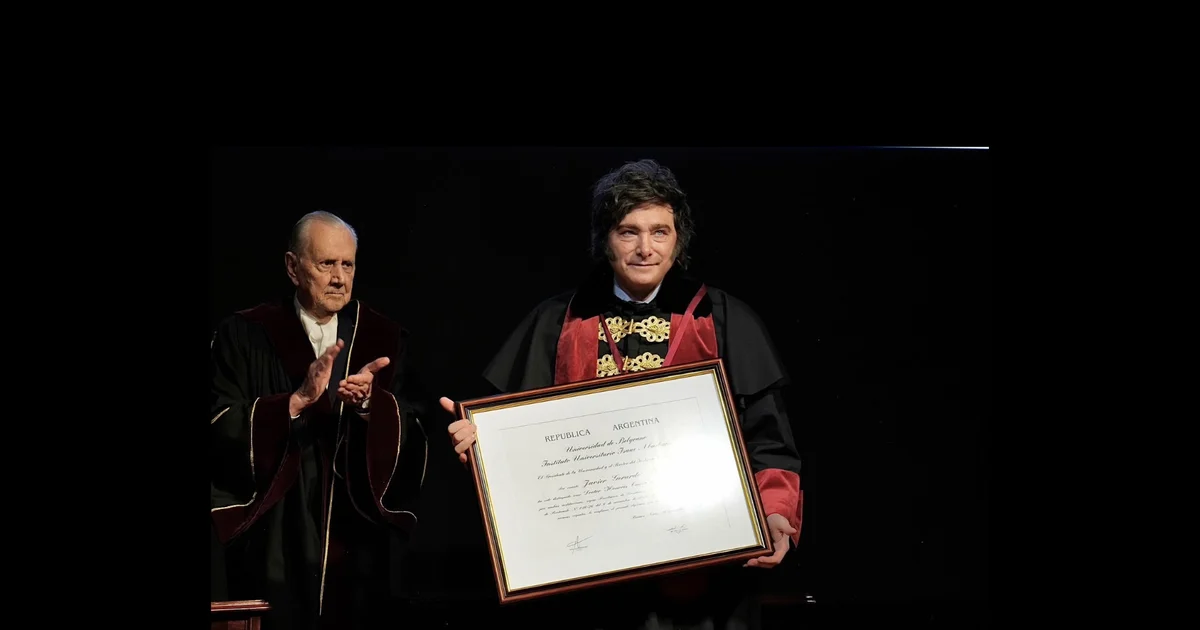
Milei expressed gratitude for the honorary doctorate at Universidad de Belgrano and emphasized the role of economic growth in overcoming poverty.
Casa Rosada31 min read
One topic in one place: the official text, the video, what happened on X, how each outlet told it and the full speech.
AI estimate · 80% confidence
Source: Casa Rosada (CC BY 2.5 AR). Translation by +enfoque
Speech by President Javier Milei after receiving the title of Doctor Honoris Causa, awarded by the University of Belgrano and the Isaac Abarbanel University Institute.
Good morning everyone. I want to express that for me it is a joy and an enormous honor to return home under these circumstances. Therefore, first of all, I would like to thank the university authorities for considering me worthy of this distinction that fills me with joy and pride. The topic I decided to address is one I have been working on for 15 years, which is why I do not even bring notes or bullets, as I usually do for my speeches, and it basically has to do with economic growth.
In recent months, I had the privilege of meeting giants in the field, such as Xavier Sala i Martín and last year's Nobel Prize winner, Philippe Aghion, and I had some very interesting dialogues with them, and the conversations always took me back to a moment in my youth when I was studying economic growth. One of the characteristics that the vast majority of economic growth books have, barring two exceptions, is that they all have some part of the book containing a phrase by Robert Lucas Jr. that states that when one begins to study this type of topics, the consequences on human well-being are so staggering that one can never think about anything else again.
I remember that the first time I read that phrase, quite typical for even a ‘rookie,’ since I was not even graduated, I had the feeling that it was the phrase of a professor who considered his subject to be the most important, which I also, from today's perspective, think is great. Each professor should consider their subject to be the most important because that is what will fuel their passion for teaching. Therefore, I hope all professors are in love with their subject because that will allow them to teach it with passion.
But beyond that, over time, the phrase gained more strength, and at one moment in my life, I decided to start focusing on long-term issues. I was very saturated with current issues, with micro-issues related to my work, and so I began to dedicate myself to looking at long-term questions. And that is where I first encounter the contradiction with neoclassical theory, which is the fact that when you look at the per capita GDP series found in the millennial economic studies of Angus Maddison, one of which is still being calculated and updated by his disciples… when you take the series from the Christian era, you will see that per capita GDP remains practically constant until around 1800, when it behaves like a hockey stick, where per capita production rises 15 times in a context where the population multiplies by 10.
That is to say, GDP increased 150 times. In economics, that is referred to as increasing returns. That is, you increased the labor input by ten, and as a result, production increased 150 times. That is, productivity grew 15 times. And the flip side of that is that extreme poverty conditions on the planet were… 95% of the population lived below the extreme poverty line, and today that number must be recalculated constantly because clearly that number would be less than 5% if the same type of measurement were maintained.
Now, therefore, what we are experiencing is the best moment in the history of humanity in terms of well-being. And that means that the natural condition of man throughout history has been poverty. That is to say, this is a relatively new phenomenon. And so what one needs to study is the creation of wealth. And here is where the reflections I had in conversations with Xavier Sala i Martín and also with Philippe Aghion come into play. They, when they dedicated themselves to studying economic growth, were motivated by what made people rise from poverty, what elevated the quality of life of human beings.
The answer was economic growth. And the reality is that the first one to ask the question correctly was Adam Smith, because Adam Smith's work on political economy, which was part of his course, that is to say, the course on moral philosophy that Adam Smith taught, had a part on theology, a part on moral philosophy, a part on political economy, and a part of law, of jurisprudence, and that, basically, jurisprudence in Adam Smith's time meant studying the philosophy of law.
That is, Adam Smith's works are designed for teaching. He was actually a very successful professor, because at that time in Scotland there was a basic pay for teachers and a variable pay that came from the payment students made as a result of enjoying being taught by that professor. Adam Smith was so popular that basically you would go to a library… a bookstore, I’m sorry, and there were even portraits of Adam Smith, just to consider the number of books that Adam Smith had. And given how expensive it was to own books, one realizes he was someone who had a very good economic standing because he was a very successful teacher; his students loved him, and he basically… he wrote the Theory of Moral Sentiments for the moral philosophy section of his course and the Inquiry into the Nature and Causes of the Wealth of Nations basically for the political economy section.
He was writing a part on jurisprudence, about what has to do with the philosophy of law, a work that, at Adam Smith's request, his friends burned, but the notes persisted, and that work could be replicated. He had also written other essays which are also fundamental for understanding… for me they're fundamental; there are other essays that Adam Smith also requested be eliminated, but there his friends did not comply, and they published them, and among those essays, for example, there is a work on astronomy.
Adam Smith, just like all members of the Scottish Enlightenment, were fanatics of Newton—a fanaticism that I share; I mean, Newton was not just another kid. And the interesting thing is that this is very important to also understand the model that Adam Smith had in his head. I mention all this because here there are two issues. The first is that Adam Smith was a techno-optimist, and then after Adam Smith came Malthus and many other techno-pessimists. The reality is that if we were to stop in the year of the publication of Adam Smith's work, if we were to do econometrics, it would seem that what Adam Smith wrote was total delusion and that Malthus was right.
However, when we stop today, we realize that the one who was right was Adam Smith and not Malthus and all the techno-pessimists. That said, there is another problem, which is that in economics… we in economics always dedicated ourselves to studying whether equilibrium exists, if it is unique, if it is stable. And we complicated things, or we diverged, or ran into some problems when we wanted to look into normative issues. And to study the optimality of equilibrium.
And that is where the problem arises. Because if there is something that characterizes in two ideas the contribution of Adam Smith in The Wealth of Nations, it is the idea of the pin factory and the idea of the invisible hand. The pin factory is precisely the idea of increasing returns. Adam Smith describes a factory where he explains that if one person had to produce only one pin, they could probably produce only 20 during the day.
However, when the division of labor is carried out by hiring 10 people, production jumps to 48,000. That is, 4,800 per capita. In other words, productivity multiplies by 240.
And Adam Smith… thus, there you have the basis for increasing returns, which is what explains economic growth. Moreover, Adam Smith also speaks of learning by doing because one of the things he states is that as one is carrying out that task, they are getting better at it, and therefore saving more time. That is, average costs go down.
Consequently, he also proposes that not only does the division of labor generate an increase in productivity, but that as you are carrying out that task more frequently, you are getting better at it and you are becoming ever more productive.
But, however, it does not stop there and he also ventures the idea of technological progress because what he states is that, well, as you are carrying out these tasks and getting better at them, at some point you discover some method that allows you to produce more with the same amount of labor or produce the same with less labor. Consequently, Adam Smith also describes technological progress.
And, there is a not insignificant issue, and that is that many times the issues of economics, especially when studying growth, particularly since the introduction of endogenously growing models, seem to present a problem where trees could grow to the sky—indeed, in some growth books there are jokes about economists regarding that. Consequently, Adam Smith was absolutely clear about this. Adam Smith was a person who managed a lot of mathematics due to his passion for Newton; indeed, Newton required knowing mathematics. And, in that context, Adam Smith points out that the division of labor, that is to say, increasing returns, is limited by the size of the market.
If we were to take this idea seriously, we would realize that all the dystopian hypotheses we have suffered over the last 250 years make no sense. That is to say, we would become aware that the Luddites have been wrong and that techno-pessimists have always been wrong. The Luddites are a movement… it is not truly known whether the anecdote about Ludd was true or not, who basically broke the mechanical loom because supposedly it generated unemployment.
The reality is that if the pessimists had been right, and I'm not even saying in the worst-case scenario where they claimed that jobs would be destroyed, but if they had simply held onto the jobs that existed; that was a very optimistic hypothesis for what the Luddites proposed. If that were true, given that the population has multiplied by ten, today the unemployment rate in the world should be 90%. That is to say, the techno-pessimists are not right. Throughout history, they have been wrong. Indeed, if Ford had spoken to a techno-pessimist, he would have said that what had to be done was essentially lighter horses or lighter carts. Well, he decided to make a car.
Thus, if we had been so concerned when man invented fire, someone would have said ‘no, no, let’s not make fire because it would lead to fires.’ Fortunately, facts impose themselves, and mankind continues to progress and the history of humanity continues to get better and better, not in all aspects, but well.
That said, what Adam Smith narrates is a story about economic growth, which is why the book is called An Inquiry into the Nature and Causes of the Wealth of Nations. The flip side of this is that in neoclassical terms, it poses a problem. The idea is that we can prove that equilibrium exists, that it is unique, and that it is stable. However, the neoclassicals have become obstinate with the idea of Pareto optimality—which is clearly an analysis that I don’t find appealing, to put it mildly. Not because I believe it lacks valuable elements, but because I think the way in which that concept was reached caused more harm than good.
The idea of Pareto optimality is that if you are in a certain situation and can improve someone without making anyone worse off, you would not be at a Pareto optimum. Therefore, if you make an improvement that benefits someone without worsening others, you have a Pareto improvement; and if that process is exhausted, then you are at the Pareto optimum. In other words, you cannot improve anyone without worsening another. Well, the first thing I want to tell you is that technological progress is not Pareto optimal. Ask yourself what happened the day Edison invented the light bulb. Candle manufacturers were not very happy. However, we lit ourselves with electric light. We will leave candles for very particular matters only.
Consequently, focusing on Pareto optimality already has a problem that does not align well with technological progress, and if there is something we want to explain, it is technological progress. The other problem we have with Pareto optimality is that it was assimilated with the idea of the invisible hand. That is, the idea that each one of us, guided by our own interest, leads to maximum general welfare.
The debate in which Adam Smith derives this reflection from the invisible hand is interesting, which was actually already implicit and is explained in the theory of moral sentiments because basically in Scotland, after it was annexed to England, it became a fabulous port and with trade with the United States, it began to enrich enormously, as every moment in which much wealth generation occurs, ideas from the left always appear wanting to appropriate the results of others.
So, basically, it was the response to those expropriating attacks from the left, wanting to use the State to take money from those who are doing well, punishing them to give it to others. That is to say, the idea of social justice in redistributive terms; which has a couple of problems: that it is unequal treatment under the law and theft. And that when you create that situation, not only are you going to penalize saving, but you are also going to penalize investment because you cannot appropriate the results. Consequently, you have an incentive problem and you end up collapsing economic growth, and society becomes impoverished.
Therefore, if you wanted to improve the situation of the most vulnerable, the outcome, let's say, the remedy was worse than the disease. That is to say, far from people being better off, they are worse off; if you want an emblematic case, that is called Argentina. From being one of the five most important countries in the world, when we arrived, we were in the middle of the table and on our way to becoming Cuba with a previous stage in Venezuela. Something that did not happen because I was fortunate enough to add to the team the best Minister of Economy in all of Argentine history: Luis ‘Toto’ Caputo, who today honors me with his presence.
That said, then the mathematical counterpart of the first Welfare Theorem, which states that every competitive equilibrium leads to a Pareto optimum; the problem is that to derive that, you no longer have to worry not only about the conditions under which you derive the demand and supply curves, but you also have to ensure that they arise from an optimization process. So now, you need the demand and supply curves for factors to arise from the maximization of utility. And on the side of firms, whether it is the supply of goods or the demand for inputs or factors, they must arise from the maximization of profit.
Now, under those conditions you have that the demand functions are optimal, that the supply functions are optimal, consequently the excess demand functions are optimal, and therefore you are in a convex, compact set, with continuous functions and if they are point-to-point applications, equilibrium exists, it is unique, and if the direct effects are furthermore stronger than the cross effects, which is quite evident, also that equilibrium is stable; but as this also emerges from a topological structure that allows it to be a maximum of the utility function and a maximum of the profit function, it is also optimal.
That structure has a superlative analytical beauty. Few more beautiful experiences have I had in reading than reading the book Theory of Value by Debreu: it is of an analytical beauty, it is imposing; reading it is wonderful, understanding it, I won't even mention. Consequently, that book and all that literature is very impactful which, strictly speaking, started with Abraham Wald, who made the proof of the existence, uniqueness, and stability of equilibrium, but without the fixed point theorems. He was truly a mathematician of substance, who was recommended by John von Neumann, another of the great geniuses in the history of humanity, among other things because he created the computer in parallel with Turing.
But not only that, but also, later, when the fixed point theorems appeared, whether it be Brouwery’s or subsequently Kakutani, the work of McKenzie surfaced, and after that of Debreu and all the discussion related to it, the reality is that those models are very attractive, but the first problem is that they do not accommodate increasing returns because if you admit increasing returns, you would have convex functions. That is to say, the problem with a convex function is that you do not find a maximum. In other words, you can find a minimum, but not a maximum. Consequently, you will have a problem with optimality.
Adam Smith resolves that situation more simply by introducing labor value theory, thus avoiding having decreasing average costs, but it caused other more serious types of problems with labor value theory. That is to say, Adam Smith had the issue of how to fix the model so that it doesn't go… trees do not grow to the clouds, and the problem in the neoclassical structure is that it eliminates increasing returns to achieve optimality.
Well, that is not minor because everything related to the regulatory structure, when you look at regulation, is that monopolies are supposedly bad and as they diverge from the Pareto optimum, they are regulated and assimilated to a competitive model; when you do that, you kill the increasing returns and that kills economic growth. If you want a concrete application of this, you have the case of Europe. They are experts in regulation, they are experts in killing increasing returns. Naturally, they are experts in having killed economic growth. That is why Europe has been stagnant for years and years.
And this is, in fact, what we do from the Ministry of Deregulation in reverse; Federico Sturzenegger's mission is precisely to break all these regulations and free increasing returns so that this generates economic growth.
So, the question is… look at the problem that neoclassical economics has brought us and how arrogant we have become as economists; that when the model does not match reality - in the case of monopolies it is called non-convexities - we call it market failure. Do you realize that this is absurd? You have reality and you have the model. And if the model does not map reality, you blame reality. It is strong.
If you are working in a company, I suggest you not do this because you are likely to receive a shock that will take you to the Moon and back. Because you will cause the businessman to lose a lot of money when you want to subject reality to the logic of the model. And if you are economic policymakers, you are much more dangerous. Because there you end up causing enormous harm to the population, disguised as good intentions.
That said, in that sense, one of the things that seems most fascinating to me is a work done by Hans-Hermann Hoppe in a book called The Ethics of Private Property. I mention this because, moreover, Hans-Hermann Hoppe hates me, which is interesting, because surely in many of the things for which he hates me he is right, indeed, I am actually proud that he hates me for that; he hates my international policy and my ardent defense of Israel. So, if he hates me for that, fantastic.
But beyond that, Murray Newton Rothbard had two disciples, one is Walter Block who adores me, and the other is Hans-Hermann Hoppe who hates me. And I do not believe in the tyranny of concave functions, that idea that extremes are bad and the middle is good. For me, that seems absurd. It appears to me to be a vomitous and unacceptable moral timidity. Because if I say to you, is respect for life good and murder bad? The tyranny of concave functions, which would be such and you can find a maximum. Fortunately, there is video and it reproduces when I sketch the concave function. Ah, then, if you think this thing that reality leads to truth, then torture, you would be thinking it is good, no, and torture is abhorrent.
That is why the issue of morality is also so important. In fact, on this day, November 30, I will be presenting my new book at the Palacio Libertad; you are invited: ‘Morality as State Policy’ because when you have to make decisions, the important thing is that you make decisions that are just, and to make just decisions…, I recognize myself as a Stoic inspired by King Solomon, but when you look at chapter 8 of Adam Smith's theory of moral sentiments, he is also a Stoic when he talks about virtue.
And what does King Solomon ask for? He asks for wisdom to discern between good and evil, courage to choose good, temperance to endure the consequences of choosing, and then he adds justice, just because he should not take measures that are just; therefore, to determine what is just, you… see, moral relativism does not work, and when I talk about moral relativism, I am not thinking of going to India and suggesting they eat cows, nor am I thinking of entering an orthodox Jewish community and showing up with a Spanish ham, I am not thinking that. I am crazy, but I don't eat glass. Basically, when I speak of non-negotiable values, they are Judeo-Christian values, so to speak, the 10 commandments.
That is to say, the principle of non-aggression, respect for life, for freedom, for property. When you make decisions, let's say, not lying, when you make decisions in line with these values contained in the ten commandments, you automatically generate the conditions under which Hans-Hermann Hoppe derives in logical terms the Pareto optimality, but without being subject to the restrictions imposed by topology; and thus all the hypotheses and all that is called market failure analysis fades away. And, consequently, all the foundations for intervening in markets are eliminated. And therefore, the doors are opened for you to unleash.
I remember a phrase that Sturzenegger said at a conference - he having participated in Macri's government and having participated and being a key figure in this government, says: “What is the difference between one government and the other? When we were in Macri's government, the State was there, and the question was how we did to do our best. Well, in this government, the question is different: should the State be doing this?” And the most interesting thing Federico tells is that at the beginning he had some divided responses. Well, as time goes on, he sees that fewer and fewer things should concern the State.
That said... But that then raises a problem. According to the neoclassicals, an inconsistency between the pin factory, increasing returns, and the invisible hand, meaning optimality. Hoppe resolves that... Furthermore, I also find the second welfare theorem aberrant. I find it even worse. The first one seems bad to me, the second one seems brutally horrifying which states that you can achieve a Pareto optimum, regardless of the distribution. Well, I think that in 1961 when they had to build the wall and in '89 when it fell on them, it shows that yes, private property is important.
Therefore, I am also a renegade of the second welfare theorem. Criticism is easy. Anyone can criticize. Some do it with reason and others do it just for the sake of criticizing and believing that it makes them intellectually superior. But just staying with criticism is not enough. And when we look at economic growth models, the economic growth models have increasing returns, they have to face the issue of non-optimality due to non-convexity, or they have externalities.
In fact, one of the hypotheses that Marshall had developed was the idea that there were constant returns to scale in all companies, all would be competitive, and the flip side of that was that there was an aggregate externality and that was what generated economic growth. It does not really... solve the problem mathematically, but with reality, it goes haywire.
Another hypothesis is to work with human capital, when Solow tested the neoclassical growth model, known as the Solow-Swan model, he discovered that only 15% was explained by per capita capital, and George Stigler told him he needed to incorporate human capital because basically if you modified human capital you would no longer be restricted to production growth by N, which was taken exogenously, which was the population growth rate. That also corrects the mathematical problem, but still does not correct the underlying problem.
Moreover, how can it be that for economic theory something that pulled so many people out of poverty is bad? That should shock us. Clearly, I love the work that Aghion and Howitt did, who are Schumpeterians, and how they address the problem of creative destruction, where basically they do not believe in the neoclassical perfect competition model. But they do believe in a model of competition among monopolies. If you had a perfectly competitive model and were not going to have quasi-rents, then you would have no incentives to invest.
Because that would imply a drain of funds that would lead you to an inferior wellbeing situation. And, moreover, if you are going to make a new product and then competition is going to eat your quasi-rent, it makes no sense to invest. So, you inevitably have to... you go and what you do is invest in some development that breaks something else that was before and generate a quasi-rent and that quasi-rent will then bring new competitors, but in the meantime you captured the quasi-rent and that is what drives the Aghion and Howitt model.
But the problem of optimality persists; one always has to deal with the issue of convexity. So, it occurred to me that this problem needed to be resolved and together with Dr. Demian Reidel we found a solution. From my point of view, the neoclassical problem is poorly formulated because reality, let’s say this quasi-hysterical, bipolar separation of Robinson who thinks like a consumer on one side and then puts on the producer's hat is more, have you ever considered, have you ever thought about the sad role of the entrepreneur in neoclassical economics at the micro level? It seems that the role of the entrepreneur could be solved by a computer, I mean, and I can assure you that process is much more complex.
Consequently, what we say is that in reality, companies belong to someone, they belong to some person. Therefore, you have to internalize within the utility function what happens with the production process. What’s more, if you have to be generating whatever product, it will be better to have increasing returns than decreasing returns. Because what could be better than putting an additional unit of labor and that the product rises more than proportionally?
That cannot be bad. So because it was poorly modeled. So what we said is that the production process has to be included inside the utility function. And this is interesting because, what happens? As you gain a unit of consumption, what happens to the utility? Utility rises, but it rises decreasingly. That is, how much would you pay for the first bottle of water in the middle of the Sahara Desert in broad daylight, anything, you would pay anything for it.
For the second less, for the third less, after drinking 10 liters if you offer them a bottle they’ll throw it at your head. That is to say that the marginal authority of consumption is decreasing. In other words, it grows, but decreasingly.
And the other thing is that as you want to have an additional unit of consumption, you will need to put in an additional unit of labor or a bit more labor and when you put that additional unit of labor, even though production grows increasingly, the problem is that this requires you to give up leisure and therefore the cost in terms of welfare, in terms of utility, increases over time. It's like if I said to you, well, look, I offer you a job for 60 million dollars a year, do you accept it? I would say it’s a decision; I would ask what you have to give in return. Because if they’re going to pay you that 60 million dollars at the end of the year, after working 12 months; if they demand that you work 24 hours a day, it’s a scam.
So, the reality is that, as you give up more leisure, the value of leisure grows, in terms of utility, exponentially. Therefore, the cost of giving up more units of labor becomes ever more costly. So what happens? On the one hand, you gain with those additional units of consumption, you gain utility, but decreasingly. And what happens? But the leisure you are giving up becomes increasingly expensive. What is interesting about this? That at some point they balance, and when they balance that allows them to have increasing returns and at the same time the model is closed; trees do not grow to infinity and you also have a situation of optimality. A great result.
But, of course, when the model becomes dynamic it becomes a little more complex; it becomes so complex that Demian had to resort to Bellman's windows to solve it, which I will warn you I have not the slightest idea of how to solve, I didn’t do it, it’s not within my skills.
It is called division of labor. I put in the ideas and he put in how to solve these problems. That said..., this is very interesting because a problem of multiple equilibria arises, that is, you have three equilibria. So, of the three equilibria, the one in the middle is unstable and the other two are stable. What does this mean? That if you are in the middle equilibrium you either go to the good equilibrium or the bad equilibrium. And it is important because what will determine whether you are in the good equilibrium or the bad equilibrium is, well, what will determine you being in the bad equilibrium, for example, is a situation where people work little, that is, they do not like to work, consequently they generate little income, save little, generate little capital and, therefore, the economy remains trapped in a poverty trap.
Now when people are more committed to a work culture, that they work more, produce more and, consequently, allow them to accumulate, you go to the good equilibrium. And, if in addition to that you regulate and remove obstacles to increasing returns, the level of production per capita, that is, the wellbeing they can reach, is higher. And, if you additionally open the economy, the market size increases and, hence, you can achieve greater increasing returns. As a solution, it is wonderful, it is a beautiful contribution. In fact, in the things we have developed, you saw that Artificial Intelligence solved what I believe are 722 mathematical problems; well, our solution in that work is part of those solutions that have been left for the history of humanity.
That said, that said, but that is the genius of Demian, that genius is not mine. That said... what is interesting? It is an article that has a very interesting contribution, but it says several important things; punishing the work culture sinks us. The idea of social justice sinks us. The idea of living off others sinks us.
That is why, it is also very important what we are doing in Human Capital, which I have Professor Álvarez here; thank you for coming, Professor. But, why is it interesting? Because when Sandra got into the position people asked for plans. And there is an underground revolution that is not being seen: and it is that today people ask for work. Sandra, in accordance with what the human capital theory postulates, made agreements with companies to set up training centers. So, each company trains people who have been left without jobs and gives them skills that allow them to reintegrate into the labor market, with the new Labor Law promoted by “Toto”’s team.
So, why is this important? Because before only 70 people were signing up; now all courses are overcrowded and we are opening these training centers all over the country because today people are asking for work. That is, people have stopped asking for alms; people understood that being a slave is not a business. Milton Friedman had a wonderful phrase and it’s in Chicago, he says: there is no such thing as a free lunch. Friedman was a practicing Jew, so he knew what he was talking about, and that is a reflection that relates to free bread… that was Egypt.
That is to say, in fact, when you are in Shabbat..., depending on whether it’s the Sephardic or Ashkenazi tradition, it’s more fun the Sephardic, where they throw the bread, they throw the challah, but why don’t they shake hands? Because that represents slavery. So, either you leave the bread there next to it; or you throw it. But why? Because if you give it to them in hand, that is slavery, it is Egypt, it was free bread.
So, we are not giving you free bread, we are not giving you free fish. We are teaching people to fish. And that is phenomenal because that is going to take Argentina out of the poverty trap to go to the good equilibrium. And, if in addition we deregulate - Federico has carried out 18,000 deregulations, and when the Hojarasca Law goes through the Senate we will be over 20,000 - it is a machine for generating increasing returns. And, therefore, it will create even more economic growth.
And not only that. If we, instead of thinking of a market of 48 million human beings, start to think of a market of over 8 billion people, there will clearly be growth. And what are we doing there? Here, I also have the privilege of having Pablo Quirno with me, who was not only fundamental in preventing hyperinflation, but after that was assigned one of the toughest positions, which is to be the Chancellor of my government. Do you know what it is like to do the diplomacy of such a character? But, well, at least I take it with humor, I do not get angry. I know I am tough and I accept it.
But having said that: when we arrived, we were only trading with 10% of the world’s population. Today we trade with 30%. We have opened more than 500 markets. We signed the European Union-Mercosur agreement, we signed the EFTA, we signed an agreement with the United States, with Singapore, with Japan, and we are entering the Trans-Pacific Partnership. If we continue like this, according to our plan, by the year 2031, we will be trading with 90% of the planet. This is going to generate a process of competition, it will generate a lot of creative destruction, and the result will be that we will gain a tremendous amount of productivity and we will grow enormously. That is to say, as the great man Alberto Benegas Lynch (h) says, there is nothing more useful than a good theory.
And we are applying good theory and it is working. Therefore, I have no doubt that we have entered the liberal Golden Age. And that Argentina will be great again. Thank you very much.
Discurso del Presidente Javier Milei tras recibir el título de Doctor Honoris Causa, otorgado por la Universidad de Belgrano y el Instituto Universitario Isaac Abarbanel
Buenos días a todos. Quiero expresar que para mí es una alegría y un honor enorme volver a casa en estas circunstancias. Así es que, en primer lugar, deseo darle las gracias a las autoridades de la universidad, por considerarme digno de esta distinción que me llena de alegría y de orgullo.El tema que decidí tratar es un tema en el cual vengo trabajando hace 15 años, por eso no traigo ni siquiera los apuntes ni los bullets, digamos, con los que suelo dar mis discursos y que, básicamente, tiene que ver con el crecimiento económico.
Estos últimos meses tuve la dicha de conocer a gigantes de la materia, como es el caso de Xavier Sala i Martín o como es el caso del Premio Nobel del año pasado, Philippe Aghion, y tuve unos diálogos muy interesantes y siempre la charla con ellos me remontaba a un momento de mi juventud cuando estudiaba crecimiento económico, y una de las características que tienen la gran mayoría de los libros de crecimiento económico, salvo dos excepciones, es que todos en alguna parte del libro tienen una frase de Robert Lucas Junior que dice que cuando uno empieza a estudiar este tipo de temas, las consecuencias sobre el bienestar humano son tan estremecedoras que ya nunca puede más pensar en otra cosa.
Recuerdo que la primera vez que leí la frase, propio de ni siquiera un “rookie” y porque todavía ni siquiera estaba graduado, tenía la sensación que era la frase propia de un profesor que consideraba que su materia era la más importante, cosa que también vista desde hoy me parece bárbaro que cada profesor considere que su materia es la más importante porque eso es lo que va a hacer es que la enseñe con pasión. Por lo tanto, ojalá todos los profesores estuvieran enamorados de su materia porque justamente le van a poner pasión para enseñarla.
Pero más allá de eso, con el paso del tiempo la frase fue tomando mayor fuerza y en un momento de mi vida decidí empezar a dedicarme a estudiar los problemas del largo plazo. Estaba muy saturado con las cuestiones de la coyuntura, con las cuestiones de micro aplicadas, vinculado a mi trabajo, y entonces empecé a dedicarme a mirar las cuestiones de largo plazo.Y ahí es donde me encuentro con la primer contradicción con la teoría neoclásica y es el hecho de que cuando ustedes miran la serie del PBI per cápita que están en los estudios de economía milenaria de Angus Maddison, una de las que hoy la siguen calculando sus discípulos y lo siguen actualizando… cuando ustedes toman la serie desde la era cristiana, ustedes van a ver que el PBI per cápita permanece prácticamente constante y, a partir del año 1800, el comportamiento como un palo de hockey, donde el producto per cápita sube 15 veces en un contexto donde la población se multiplica por 10.
Es decir que el PBI subió 150 veces.Eso en economía se llaman rendimientos crecientes. Es decir, ustedes incrementaron por diez el insumo trabajo y como consecuencia eso el producto subió 150 veces. Es decir, la productividad creció 15 veces. Y la contracara de eso es que las condiciones de pobreza extremo en el planeta eran… el 95% de la población vivía debajo de la línea de pobreza extrema y hoy ese número tiene que ser recalculado permanentemente porque claramente ese número sería menos del 5% si se mantuviera el mismo tipo de medida.
Ahora, por lo tanto, lo que estamos viviendo es el mejor momento de la historia de la humanidad en términos de bienestar. Y eso significa que la condición natural del hombre a lo largo de la historia había sido la pobreza. Es decir, esto es un fenómeno relativamente nuevo. Y entonces lo que uno tiene que estudiar es la creación de riqueza. Y acá es donde las reflexiones que tuve las charlas con Xavier Sala i Martín y que tuve también con Philippe Aghion es que ellos, cuando se dedicaron a estudiar crecimiento económico, lo que los motivaba era qué era lo que hacía salir a la gente de la pobreza, qué era lo que le elevaba la calidad de vida de los seres humanos.
La respuesta era el crecimiento económico. Y, la realidad es que el primero que se hizo la pregunta correctamente fue Adam Smith, porque el trabajo sobre economía política de Adam Smith, que era parte de su curso, es decir, el curso de filosofía moral que daba Adam Smith tenía una parte de teología, tenía una parte de filosofía moral, tenía una parte de economía política y tenía una parte de derecho, de jurisprudencia, y que, básicamente, jurisprudencia en la época de Adam Smith era estudiar la filosofía del derecho.
Es decir, con lo cual las obras de Adam Smith están pensadas para dar clases, que de hecho era un profesor muy exitoso, porque en aquella época en Escocia había una retribución básica para el docente y había una retribución variable que surgía del pago que hacían los alumnos como consecuencia de que les gustaba cursar con ese profesor. El caso de Adam Smith era tan popular que básicamente ustedes iban a una biblioteca… a una librería, perdón, y hasta había cuadros de Adam Smith, solo digamos por considerar la cantidad de libros que tenía Adam Smith y con lo caro que era tener libros uno se da cuenta que era una persona que tenía un muy buen pasar económico y es porque era un docente muy exitoso, sus alumnos lo amaban, y él básicamente…la teoría de los sentimientos morales la escribió para la parte de su curso sobre filosofía moral, la investigación sobre la naturaleza de las causas de las riquezas de las naciones la escribió básicamente para la parte de economía política.
Estaba escribiendo una parte sobre jurisprudencia, sobre lo que tiene que ver con la filosofía del derecho, obra que, a pedido de Adán Smith, sus amigos la quemaron, pero persistieron los apuntes y se ha podido replicar ese trabajo. Y había escrito otros ensayos que también es parte de entender…, para mí es fundamental, hay otros ensayos que Adam Smith también pidió que se eliminaran, pero ahí los amigos no le cumplieron y sí los publicaron, y dentro de esos ensayos, por ejemplo, hay un trabajo sobre astronomía.
Adam Smith, igual que todos los miembros de la Ilustración escocesa, eran fanáticos de Newton, fanatismo que comparto, digo, Newton no era un chico más. Y lo interesante, esto es muy importante para entender también el modelo que tenía en la cabeza Adam Smith. Menciono todo esto porque acá hay dos cuestiones. La primera es que Adam Smith era un tecno optimista, y después de Adam Smith vino Malthus y vinieron muchísimos tecnopesimistas. La realidad es que, si nos paramos en el año en que se publicó la obra de Adam Smith, si hiciéramos la econometría, pareciera que lo que escribió Adam Smith era un delirio total y que Malthus tenía razón.
Sin embargo, cuando nos paramos hoy nos damos cuenta que el que tenía razón era Adam Smith y no Malthus y todos los tecnopesimistas.Dicho esto, hay otro problema más, que cuando en economía… nosotros en economía siempre nos dedicábamos a estudiar si el equilibrio existe, si es único, si es estable. Y la complicamos o nos desviamos o metimos algunos problemas cuando nos quisimos a poner a mirar las cuestiones normativas. Y a estudiar la optimalidad del equilibrio.
Y ahí es donde aparece el problema. Porque si hay algo que caracteriza en dos ideas la contribución de Adam Smith en “La riqueza de las naciones”, es la idea de la fábrica de alfileres y la idea de la mano invisible. La fábrica de alfileres, justamente, es la idea de los rendimientos crecientes. Adam Smith describe una fábrica donde él explica que si una persona tuviera que producir solo un alfiler probablemente durante la jornada podía producir solamente 20.
Sin embargo, cuando se lleva a cabo la división del trabajo y contratando a 10 personas, la producción salta a 48.000. Es decir, a 4.800 per cápita. Es decir, la productividad se multiplica por 240.
Y Adam Smith…con lo cual, ustedes ahí tienen la base de los rendimientos crecientes, que es lo que explica el crecimiento económico y, además, Adam Smith también habla del learning by doing porque una de las cosas que dice es que en la medida que está haciendo esa tarea cada vez la hace mejor, y por lo tanto cada vez ahorra más tiempo. Es decir, va bajando los costos medios.
Consecuentemente, también plantea no solo que la división del trabajo le genera un aumento en la productividad, sino que en la medida que ustedes van haciendo esa tarea más recurrentemente cada vez la hace mejor y son cada vez más productivos.
Pero, sin embargo, tampoco se queda ahí y ensaya también la idea del progreso tecnológico porque lo que dice es que, bueno, en la medida que ustedes van haciendo estas tareas y cada vez la van haciendo mejor, en algún momento descubren algún método que les permite producir más con la misma cantidad de trabajo y eso es un salto de productividad o con menos trabajo producir lo mismo. Consecuentemente, también Alan Smith describe el progreso tecnológico.
Y, hay un tema no menor, y es que muchas veces las cuestiones de la economía y, sobre todo cuando uno estudia crecimiento, en especial desde que entró con los modelos de crecimiento endógeno, pareciera que hay un problema donde los árboles podrían crecer hasta el cielo - de hecho, en algunos libros de crecimiento hay bromas sobre los economistas al respecto. Consecuentemente, y eso Adam Smith lo tenía clarísimo. Adam Smith era un tipo que manejaba mucha matemática dado su pasión por Newton, eeer a Newton requería saber de matemáticas. Y, en ese contexto, Adam Smith lo que señala es que la división del trabajo, es decir, los rendimientos crecientes, está limitado por el tamaño del mercado.
Si esta idea nosotros nos la tomáramos en serio, todas las hipótesis distópicas con las que hemos padecido en los últimos 250 años, nos daríamos cuenta que no tienen sentido. Es decir, tomaríamos conciencia de que los luditas han estado equivocados y que los técnicos pesimistas siempre han estado equivocados. Los luditas es un movimiento… no se sabe verdaderamente si fue cierto o no la anécdota sobre Ludd, que básicamente cuando apareció el telar mecánico fue y lo rompió porque supuestamente eso generaba desempleo.
La realidad es que, si los pesimistas hubieran tenido razón, y ya no digo el peor de los casos donde decían que se destruían los puestos de trabajo, sino que se mantuvieran los que había; que esa era una hipótesis muy optimista para lo que plantean los luditas. Si eso fuera cierto, dado que la población se multiplicó por diez, hoy la tasa de desempleo en el mundo debería ser 90%. Es decir que los tecnopesimistas no tienen razón. A lo largo de la historia se han equivocado. Es más, seguramente si Ford hubiera hablado con un tecnopesimista le iba a decir que lo que había que hacer era, básicamente, caballos más ligeros o carros más livianos. Bueno, él decidió hacer un auto.
Entonces, si hubiéramos estado así también cuando el hombre inventó el fuego alguien hubiera dicho ‘no, no hagamos el fuego porque básicamente va a haber incendios’. Bueno, afortunadamente los hechos se terminan imponiendo y el hombre sigue progresando y la historia de la humanidad sigue siendo cada vez mejor, no en todos los aspectos, pero bueno.
Dicho esto, lo que cuenta Adam Smith es una historia sobre el crecimiento económico, de ahí que el libro se llama Investigación sobre la naturaleza y la causa de la riqueza de las naciones. La contraparte de esto es que en términos neoclásicos plantea un problema. La idea es que nosotros podemos probar que el equilibrio existe, que es su único y es estable. Pero, después, los neoclásicos se empecinaron con la idea de la optimalidad de Pareto -claramente que es un análisis que no me cae simpático, por decirlo de manera elegante. No porque crea que no tiene cosas valiosas, lo que creo es que la forma en la cual se arribó a ese concepto trajo más daños que beneficios.
La idea del óptimo de Pareto es que, si ustedes están en una determinada situación y pueden mejorar a alguien sin empeorar a nadie, ustedes no estarían en un óptimo de Pareto y entonces si hacen una mejora, la cual mejora a alguien sin empeorar a los otros, ustedes tienen una mejora paretiana, y si ese proceso está agotado, entonces están en el óptimo de Pareto. Es decir, no pueden mejorar a nadie sin empeorar a otro. Bueno, lo primero que quiero contarles es que el progreso tecnológico no es óptimo de Pareto. Pregúntense qué pasó el día que Edison inventó la lamparita. Los fabricantes de velas no estaban muy contentos. Sin embargo, nos iluminamos con luz eléctrica. Las velas las dejaremos para cuestiones muy particulares nada más.
Consecuentemente, focalizarse sobre el óptimo de Pareto ya tiene un problema que no se lleva bien con el progreso tecnológico y si hay algo que queremos explicar es el progreso tecnológico. El otro problema que tenemos con el óptimo de Pareto es que se trató asimilar con la idea de la mano invisible. Es decir, esa idea de que cada uno de nosotros guiados por nuestro propio interés conduce al máximo bienestar general.
Es interesante el debate en el cual Adam Smith deriva esta reflexión de la mano invisible que, en realidad, ya estaba implícita y está explicada en la teoría de los sentimientos morales porque básicamente en Escocia luego de que queda anexada a Inglaterra y que se convierte en un puerto fabuloso y que con el comercio con Estados Unidos empieza a enriquecer enormemente, como cada momento en el cual se produce mucha generación de riqueza, siempre aparecen las ideas de la izquierda de que quieren apropiarse del resultado de otro.
Entonces, básicamente era la respuesta a esos ataques expropiadores de la izquierda, de querer usar el Estado para sacar el dinero a los que va bien, castigándolos para dárselos a otro. Es decir, la idea de la justicia social en términos redistributivos; que tiene un par de problemas: que es un trato desigual frente a la ley y el robo. Y que cuando ustedes generan esa situación, no solo que van a estar penalizando el ahorro, también van a estar penalizando la inversión porque no se pueden apropiar de los resultados. Y, consecuentemente, tienen un problema de incentivos y se les cae el crecimiento económico y la sociedad empobrece.
Por lo tanto, si querían mejorar la situación de los más vulnerables, el resultado digamos, el remedio fue peor que la enfermedad. Es decir, lejos de estar la gente mejor, está peor; si quieren un caso emblemático eso se llama Argentina. De ser un país de los cinco más importantes del mundo, cuando nosotros llegamos estábamos en la mitad de la tabla e íbamos camino a convertirnos en Cuba con un estadio previo en Venezuela. Algo que no sucedió porque tuve la dicha de poder sumar al equipo al mejor ministro de Economía de toda la historia argentina: Luis ‘Toto’ Caputo, que hoy me honra con su presencia.
Dicho esto, entonces la contraparte matemática del primer Teorema del Bienestar, que todo equilibrio competitivo deriva en un óptimo de Pareto; el problema es que para derivar que eso sea… ustedes para derivar ese resultado, ya no se tienen que preocupar por, no solo por las condiciones bajo las cuales ustedes derivan las curvas de demanda y oferta, sino que además ahora esas tienen que surgir de un proceso de optimización. Entonces, ahora, ustedes necesitan que las curvas de demanda y oferta de factores surja de la maximización de la utilidad. Y por el lado de las firmas, ya sea la oferta de bienes y la demanda de insumos o de factores, tienen que surgir de la maximización del beneficio.
Ahora, bajo esas condiciones ustedes tienen que las funciones de demandas son óptimas, que las funciones de oferta son óptimas, consecuentemente las funciones de exceso de demandas son óptimas, y por lo tanto ustedes están en un conjunto convexo, compacto, con funciones continuas y si son aplicaciones punto a punto el equilibrio existe, es único, y si además los efectos directos son más fuertes que los cruzados, lo cual es bastante evidente, además ese equilibrio es estable, pero como además esto sale de una estructura topológica que permite que sea un máximo de la función de utilidad y un máximo de la función de los beneficios, además es óptimo.
Esa estructura que tiene una belleza analítica superlativa. Pocas experiencias más bellas he tenido en materia de lectura que leer el libro Theory of Value de Debreu: es de una belleza analítica, es imponente; leerlo es maravilloso, entenderlo, ni les cuento. Consecuentemente, es muy impactante ese libro y toda esa literatura que, en estricto rigor, arrancó con Abraham Wald, que hizo la demostración de la existencia, unicidad y estabilidad del equilibrio, pero sin los teoremas de punto fijo. Ese era verdaderamente un matemático de fuste, que había recomendado John von Neumann, otro de los grandes genios de la historia de la humanidad, entre otras cosas porque creó la computadora en paralelo con Turing.
Pero no solo eso, sino que, además, eso después, cuando aparecieron los teoremas de puntos fijos, ya sea el de Brouwery luego el de Kakutani apareció el trabajo de McKenzie, y después de Debreu y toda la discusión al respecto la realidad es que nosotros, esos modelos son muy atractivos, pero el primer problema es que no admite los rendimientos crecientes porque si ustedes admitieran los rendimientos crecientes tendrían funciones convexas. Es decir, el problema de una función convexa es que ustedes no encuentran un máximo. Es decir, pueden encontrar un mínimo, pero no un máximo. Consecuentemente van a tener un problema con la optimalidad.
Adam Smith de esa situación la resuelve de una manera más simple, metiendo la teoría del valor-trabajo, entonces eso evita que ustedes tengan costos medios decrecientes, pero causó otro tipo de problemas más graves la teoría valor-trabajo. Es decir que de Adam Smith tenía la cuestión de cómo fijar el modelo para que no se le vaya… los árboles no crecieran hasta las nubes y el problema en la estructura neoclásica es que elimina los rendimientos crecientes para poder conseguir la optimalidad.
Bueno eso no es menor porque todo lo que tiene que ver la estructura regulatoria cuando ustedes miran regulación es que los monopolios supuestamente son malos y como se alejan del óptimo de Pareto entonces son regulados y se los asimila a un modelo competitivo, cuando ustedes hacen eso le matan los rendimientos crecientes y eso mata el crecimiento económico. Si ustedes quieren una aplicación concreta de eso tienen el caso de Europa. Son expertos en regular, son expertos en matar los rendimientos crecientes. Naturalmente, son expertos en haber matado el crecimiento económico. Por eso, Europa hace años y años que está estancada.
Y eso, de hecho, es lo que nosotros hacemos desde el Ministerio de Desregulación al revés, la misión de Federico Sturzenegger es justamente estar rompiendo todas estas regulaciones y liberar rendimientos crecientes para que esto genere crecimiento económico.
Entonces, la pregunta es… fíjese al problema que nos llevó la economía neoclásica y lo arrogante que nos volvimos los economistas, que cuando ustedes, el modelo no mapea con la realidad - en el caso de los monopolios se llama no convexidades - lo llamamos fallo de mercado. ¿Ustedes se dan cuenta que eso es un disparate? Ustedes tienen la realidad y tienen el modelo. Y si el modelo no mapea con la realidad, le echan la culpa a la realidad. Es fuerte.
Si están trabajando en una empresa les sugiero que no lo hagan, porque probablemente van a recibir una descarga que los va a llevar hasta la Luna, ida y vuelta. Porque le van a hacer perder mucha plata al empresario cuando quieran someter la realidad a la lógica del modelo. Y si son hacedores de política económica, son muchísimos más peligrosos. Porque ahí encima terminan causando daños enormes a la población, disfrazado de buenas intenciones.
Dicho esto, en ese sentido, una de las cosas que me parece más fascinantes es un trabajo que ha hecho Hans-Hermann Hoppe en un libro que se llama La ética de la propiedad privada. Esto lo menciono porque además Hans-Hermann Hoppe me odia, esto es interesante, que además seguramente en muchas de las cosas por las que me odia además tiene razón, es más, de algunas estoy orgulloso que me odie por eso, odia mi política internacional y mi defensa encendida de Israel. Así que, si me odia por eso, fantástico.
Pero más allá de eso, Murray Newton Rothbard tuvo dos discípulos, uno es Walter Block que me adora y, el otro, es Hans-Hermann Hoppe que me odia. Y yo no creo en la tiranía de las funciones cóncavas, eso de que los extremos están mal y el medio está bien. Para mí eso me parece un disparate. Me parece de una tibieza moral vomitiva e inaceptable. Porque si yo les digo, ¿el respeto a la vida está bien y asesinar está mal? La tiranía de las funciones cóncavas que serían funciones así y ustedes le pueden encontrar un máximo. Afortunadamente hay video y reproduce cuando dibujo la función cóncava. Ah, entonces, si ustedes piensan esta cosa de que la realidad pasa por la verdad, entonces la tortura, entonces les estaría pareciendo que es buena, no, y la tortura es aberrante.
Por eso también es tan importante el tema de la moral. De hecho, este día, el 30 de noviembre voy a estar exponiendo en el Palacio Libertad mi nuevo libro; están invitados: ‘La moral como política de Estado’ porque cuando ustedes tienen que tomar decisiones, lo importante es que tomen decisiones que son justas, y para tomar decisiones justas…, yo me auto reconozco un estoico inspirado en el Rey Salomón, pero cuando ustedes miran el capítulo 8 de la teoría de los sentimientos morales de Adam Smith también es un estoico cuando habla de la virtud.
¿Y qué es lo que pide el Rey Salomón? Pide sabiduría para discernir entre el bien y el mal, coraje para elegir el bien, templanza para bancarse las consecuencias de elegir y después agrega justicia, justamente porque no tiene que tomar medidas que son justas, por ende, tampoco, para poder determinar qué es justo, ustedes…, miren, no va el relativismo moral, y cuando hablo de relativismo moral no es que estoy pensando ir a la India y sugerirles que coman vacas, ni tampoco estoy pensando en ingresar en una comunidad judía ortodoxa y caerme con un jamón español, no estoy pensando en eso. Soy loco, pero no como vidrio. Básicamente, cuando hablo de los valores que no son negociables son los valores judeocristianos, digamos los 10 mandamientos.
Es decir, el principio de no agresión, el respeto por la vida, por la libertad, la propiedad. Cuando ustedes toman decisiones, digamos, no mentir, cuando ustedes toman decisiones acordes a estos valores que están en los diez mandamientos, automáticamente generan las condiciones bajo las cuales Hans-Hermann Hoppe deriva en términos lógicos la optimalidad de Pareto, pero sin estar sujeto a las restricciones que impone la topología y por ende todas las hipótesis y todo lo que se llama el análisis de fallo de mercado se desvanece.Y, por lo tanto, se termina con todos los fundamentos por los cuales se intervienen los mercados. Y, por lo tanto, se abren las puertas a que ustedes liberen.
Yo me acuerdo de una frase que dio Sturzenegger en una conferencia -él habiendo participado en el gobierno de Macri y habiendo participado y siendo una pieza clave en este gobierno, dice: “¿cuál es la diferencia entre un gobierno y el otro?Cuando estábamos en el gobierno de Macri el Estado estaba ahí y la pregunta es cómo hacíamos para hacer lo mejor. Bueno, en este gobierno la pregunta es otra, es ¿esto lo tiene que hacer el Estado?” Y lo más interesante que cuenta Federico es que al inicio tenía algunas respuestas divididas. Bueno, con el paso del tiempo cada vez ve que menos cosas son las que se debería ocupar el Estado.
Dicho esto… Pero eso entonces plantea un problema. Según los neoclásicos, una inconsistencia entre la fábrica alfileres, los rendimientos crecientes y la mano invisible, es decir la optimalidad. Hoppe eso lo resuelve… Además, también me parece aberrante el segundo teorema de bienestar. Me parece aún peor todavía. El primero me parece malo, el segundo me parece ya brutalmente espantoso que dice que ustedes pueden alcanzar un óptimo de Pareto, independientemente de la distribución. Bueno, me parece que en 1961 cuando tuvieron que construir el muro y en el 89 cuando se les cayó encima, muestra que sí, la propiedad privada es importante.
Por lo tanto, también soy un renegado del segundo teorema del bienestar. Criticar es fácil. Criticar puede criticar cualquiera. Algunos lo hacen con fundamentos y otros lo hacen por el solo hecho de criticar y creer que eso los hace intelectualmente superiores. Pero quedarnos con la crítica no alcanzaba. Y cuando nosotros miramos los modelos de crecimiento económico, los modelos de crecimiento económico tienen rendimientos crecientes, tienen que enfrentar el problema de la no optimalidad por no convexidad, o tienen externalidades.
De hecho, una de las hipótesis que había desarrollado Marshall, era la idea de que había rendimientos constantes a escala en todas las empresas, todas serán competitivas, y la contracara de eso era que había una externalidad agregada y que eso era lo que generaba el crecimiento económico. No es muy…resuelve el problema matemáticamente, pero con la realidad se va de patadas.
Otra hipótesis es trabajar con el capital humano, cuando Solow testeó el modelo de crecimiento neoclásico, conocido como modelo Solow-Swan, descubrió que solamente explicaba el 15% el capital per cápita, y George Stigler le dijo que tenía que incorporar el capital humano porque básicamente si ustedes modificaban el capital humano dejaban de estar restringidos al crecimiento en la producción por N que se tomaba exógena, que era la tasa de crecimiento de la población. Eso también corrige el problema matemático, pero sigue sin corregir el problema de fondo.
Además, ¿cómo puede ser que para la teoría económica sea malo algo que sacó tanta gente de la pobreza? Eso es lo que nos debería impactar. Claramente a mí me encanta el trabajo que hicieron a Aghion y Howitt, que son schumpeterianos, y cómo tratan el problema de la destrucción creativa, donde básicamente no creen en el modelo de competencia perfecta neoclásico. Pero sí creen en un modelo de competencia entre monopolios. Si ustedes tuvieran un modelo perfectamente competitivo y no van a tener cuasi rentas, entonces ustedes no van a tener incentivos a invertir.
Porque eso implicaría un drenaje de fondos que los llevaría a una situación de bienestar inferior. Y, además, si van a hacer un producto nuevo y después la competencia les va a comer la cuasi renta, no tiene sentido invertir. Entonces, forzosamente tienen…, ustedes van y lo que hacen es invertir hacia algún desarrollo que rompe otra cosa que estaba antes y generan una cuasi renta y esa cuasi renta después va a traer nuevos competidores, pero en el mientras tanto ustedes capturaron la cuasi renta y eso es lo que mueve el modelo de Aghion y Howitt.
Pero sigue estando el problema de la optimalidad, siempre hay que estar lidiando con el tema de la convexidad. Entonces, a mí se me ocurrió que había que resolver ese problema y junto al Doctor Demian Reidel encontramos una solución. Desde mi punto de vista, está mal formulado el problema neoclásico porque la realidad digamos esta separación cuasi histérica, bipolar de Robinson que por un lado piensa como consumidor y después se pone el bonete como productor, es más, ¿nunca se pensaron, nunca se pusieron a pensar el triste rol del empresario en la economía neoclásica en la micro? Parece que el rol del empresario lo pudiera resolver una computadora, o sea, y les puedo asegurar que es bastante más complejo ese proceso.
Consecuentemente, lo que nosotros decimos es que en realidad las empresas son de alguien, son de alguna persona. Consecuentemente, ustedes tienen que internalizar, dentro de la función de utilidad, lo que ocurre con el proceso productivo. Es más, si ustedes tienen que estar generando el producto que sea, les va a resultar mejor tener rendimientos crecientes que rendimientos decrecientes. Porque qué más que poner una unidad adicional de trabajo y que el producto le suba más que proporcionalmente.
Eso no puede ser malo. Entonces porque estaba mal modelado. Entonces lo que nosotros dijimos es que el proceso productivo hay que meterlo adentro la función de utilidad. Y esto es interesante porque, ¿qué es lo que sucede? En la medida que ustedes ganan una unidad de consumo, ¿qué pasa con la utilidad? La utilidad sube, pero sube decrecientemente. Es decir, cuánto pagarían por la primera botella de agua en el medio del desierto de Sahara a plena luz del día ahí, cualquier cosa, todo pagarían.
Por la segunda menos, por la tercera menos, después de que se tomen 10 litros si le acercan una botella se la revolean por la cabeza. Es decir que la autoridad marginal del consumo es decreciente. Es decir, crece, pero decrecientemente.
Y lo otro es que en la medida que ustedes quieren tener una unidad adicional de consumo, ustedes van a necesitar meter una unidad adicional de trabajo o algo más de trabajo y cuando ustedes pongan esa unidad adicional de trabajo, por más que la producción crezca crecientemente el problema es que eso requiere que ustedes entreguen ocio y entonces el costo en términos de bienestar, de utilidad, es creciente en el tiempo. Es como si yo les dijera bueno, miren, les ofrezco un trabajo de 60 millones de dólares al año, ¿lo aceptan? Yo diría que es una decisión, les preguntaría qué tienen que poner a cambio. Porque si esos 60 millones de dólares se los van a pagar a fin de año, después de trabajar 12 meses; si les exigen que trabajen 24 horas por día, es una estafa.
Entonces, la realidad es que, conforme ustedes van entregando más ocio, el valor de ocio va creciendo, en términos de utilidad, exponencialmente. Por lo tanto, el costo de entregar más unidades de trabajo se hace cada vez más costoso. Entonces, ¿qué es lo que pasa? Ustedes, por un lado, ganan con esas unidades de consumo adicionales, ganan utilidad, pero decrecientemente. ¿Y qué es lo que pasa? Pero el ocio que van entregando cada vez es más caro. ¿Qué es lo interesante de esto? Que en algún momento se empatan, y cuando se empatan eso les permite tener rendimientos crecientes y al mismo tiempo el modelo está cerrado, los árboles no crecen al infinito y además tienen una situación de optimalidad. Resultadazo.
Pero, claro, el modelo cuando se vuelve dinámico se vuelve un poquito más complejo, se pone tan complejo que Demian tuvo que recurrir a las ventanas digamos de Bellman para resolverlo, que ya les aviso que no tengo ni la más pálida idea de cómo se resuelve eso, no lo hice yo, no está dentro de mis skills.
Se llama división del trabajo. Yo puse las ideas y él puso cómo resolver estos problemas. Dicho esto…, esto es muy interesante porque aparece un problema de equilibrios múltiples, o sea, ustedes tienen tres equilibrios. Entonces, de los tres equilibrios, el del medio es inestable y los otros dos son estables. ¿Qué quiere decir esto? Que si ustedes están en el del medio o se van al equilibrio bueno o al equilibrio malo. Y es importante porque qué es lo que va a determinar que estén en el equilibrio bueno o en el equilibrio malo. Bueno, lo que va a determinar que estén en el equilibrio malo, por ejemplo, es una situación donde la gente trabaja poco, o sea, no le gusta trabajar, consecuentemente genera poco ingreso, ahorra poco, genera poco capital y, consecuentemente, la economía queda atrapada en una trampa de pobreza.
Ahora cuando la gente está más comprometida con la cultura del trabajo, que trabaja más, produce más y, consecuentemente, les permite acumular, ustedes se van al equilibrio bueno. Y, si además ustedes regulan y le quitan trabas a los rendimientos crecientes, al nivel de producción per cápita, o sea el bienestar que pueden llegar, es más alto. Y, además si ustedes abren la economía, el tamaño del mercado aumenta y, por ende, pueden tener mayores rendimientos crecientes. Como solución es maravillosa, es una contribución hermosa. De hecho, en las cosas que hemos desarrollado, vieron que la Inteligencia Artificial resolvió creo que son 722 problemas matemáticos; bueno, nuestra solución en ese trabajo es parte de esas soluciones que han quedado para la historia de la humanidad.
Dicho esto, dicho esto, pero eso es la genialidad de Demian, no es mía esa genialidad. Dicho esto… ¿qué es lo interesante? Es un artículo que tiene una contribución muy interesante, pero dice varias cosas que son importantes; castigar la cultura del trabajo nos hunde. La idea de la justicia social nos hunde. La idea de vivir del otro nos hunde.
Por eso, también es muy importante lo que estamos haciendo en Capital Humano, que acá lo tengo al Profe Álvarez; gracias por venir, Profe. Pero, ¿por qué es interesante? Porque cuando Sandra llegó al cargo la gente le pedía planes. Y hay una revolución subterránea, que no se está viendo: y es que hoy la gente le pide trabajo. Sandra, acorde a lo que postula la teoría del capital humano, hizo acuerdos con empresas para armar centros de capacitación. Entonces, cada empresa capacita a personas que se han quedado sin trabajo y le da oficio que les permita reinsertarse en el mercado laboral, con la nueva Ley Laboral que impulsó el equipo de “Toto”.
Entonces, ¿por qué es importante esto? Porque antes apenas se anotaban 70 personas; ahora están todos los cursos abarrotados y estamos abriendo estos centros de capacitación por todo el país porque hoy la gente pide trabajo. Es decir, la gente dejó de pedir limosna, la gente entendió que no es negocio ser esclavo. Milton Friedman tenía una frase maravillosa y que está en Chicago, dice: no hay tal cosa como un almuerzo gratis. Friedman era judío practicante, o sea, sabía de lo que hablaba y esa es una reflexión que tiene que ver que el pan gratis… eso era Egipto.
Es decir, de hecho, cuando ustedes están en shabat…, depende si sea la tradición sefardí o ashkenazi, más divertido la sefardí, que se tira el pan, se tira la jalá, pero ¿por qué no se dan la mano? Porque eso representa la esclavitud. Entonces, o le dejan el pan ahí al lado; o se lo tiran. Pero, ¿por qué? Porque si se lo dan en la mano eso es la esclavitud, es Egipto, era el pan gratis.
Con lo cual, nosotros no les estamos dando el pan gratis, nosotros no le estamos dando el pescado gratis. Nosotros estamos enseñando a pescar a la gente. Y eso es fenomenal, porque eso va a sacar a la Argentina de la trampa de la pobreza para ir al equilibrio bueno. Y, si además desregulamos -Federico lleva hechas 18.000 desregulaciones, y cuando salga en el Senado la Ley de Hojarasca vamos a estar pasando las 20.000 - es una máquina de generar rendimientos crecientes. Y, por lo tanto, se va a generar todavía más crecimiento económico.
Y no solo eso. Si nosotros en lugar de pensar en un mercado de 48 millones de seres humanos empezamos a pensar en un mercado de más de 8.000 millones de personas, claramente va a haber crecimiento. ¿Y qué estamos haciendo ahí? Acá también tengo el privilegio de tenerlo a Pablo Quirno, que no solo fue fundamental para evitar la híper, sino que dado eso después le tocó uno de los cargos más difícil, que es ser el Canciller de mi gobierno. ¿Ustedes saben lo que es hacer la diplomacia de semejante personaje? Pero, bueno, por lo menos me lo tomo con humor, no me enojo. Sé que soy cabrón y lo asumo.
Pero dicho esto: cuando nosotros llegamos solamente comercializábamos con el 10% de la población del planeta. Hoy comercializamos con el 30%. Hemos abierto más de 500 mercados. Firmamos el acuerdo Unión Europea-Mercosur, firmamos el EFTA, firmamos un acuerdo con Estados Unidos, con Singapur, con Japón, estamos entrando en el Transpacífico. Si seguimos así, acorde a lo que es nuestro plan, para el año 2031, estaremos comercializando con el 90% del planeta. Eso va a generar un proceso de competencia, va a generar mucha destrucción creativa y el resultado va a ser que vamos a ganar muchísima productividad y vamos a crecer enormemente. Es decir que, como dice el Prócer Alberto Benegas Lynch (h), dice no hay nada más útil que una buena teoría.
Y estamos aplicando buena teoría y está funcionando. Por lo tanto, no tengo ninguna duda que hemos ingresado en el siglo de Oro liberal. Y que Argentina va a ser grande nuevamente. Muchísimas gracias.
Full original text in Spanish, published by Casa Rosada.
Institutional · Casa Rosada
Three plans: El Resumen Esencial for free, Premium with the full analysis and Intelligence with data and alerts to decide, in English, Spanish or Portuguese.
Three plans: El Resumen Esencial for free, Premium with the full analysis and Intelligence with data and alerts to decide, in English, Spanish or Portuguese.
Copied verbatim from the official speech; translation by +enfoque.
“We are teaching people to fish. And that is phenomenal because that will get Argentina out of the poverty trap and into the good equilibrium.”
— Javier Milei · See it in the speech
“We are not giving them free bread, we are not giving them free fish.”
— Javier Milei · See it in the speech
“I have no doubt that we have entered the golden age of liberalism. And that Argentina will be great again.”
— Javier Milei · See it in the speech