Three plans: El Resumen Esencial for free, Premium with the full analysis and Intelligence with data and alerts to decide, in English, Spanish or Portuguese.
Three plans: El Resumen Esencial for free, Premium with the full analysis and Intelligence with data and alerts to decide, in English, Spanish or Portuguese.
Three plans: El Resumen Esencial for free, Premium with the full analysis and Intelligence with data and alerts to decide, in English, Spanish or Portuguese.
One topic in one place: the official text, the video, what happened on X, how each outlet told it and the full speech.
🔥 HIGH IMPACT · Full speech · Institutional
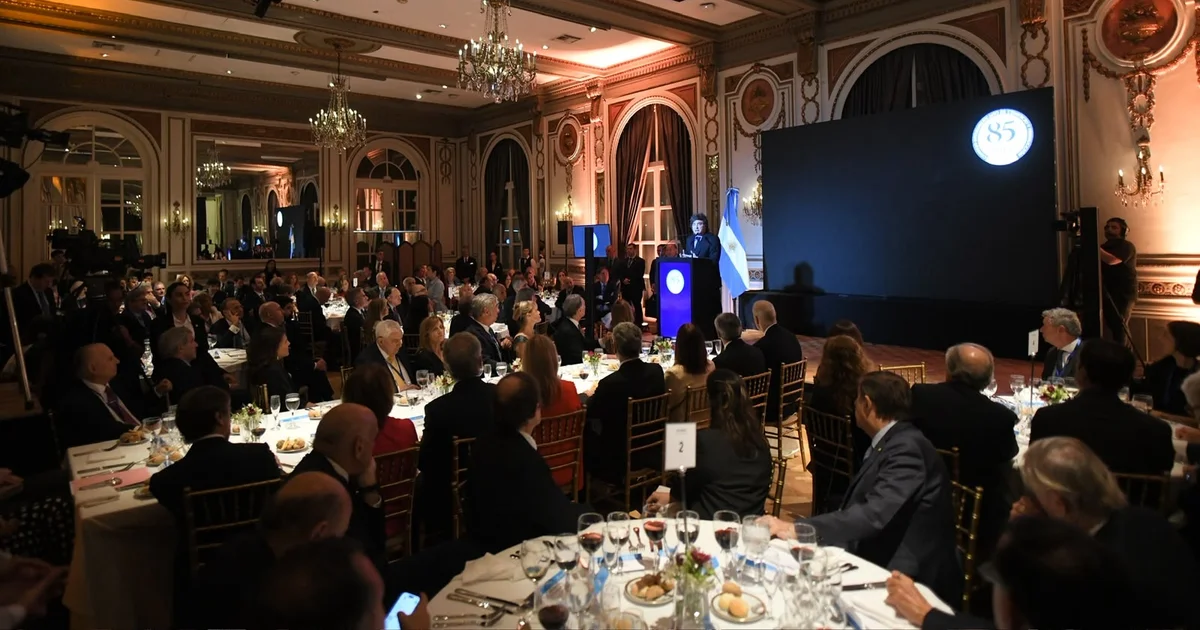
Milei stated at CICyP that Argentina lays the groundwork for a golden century through economic growth and reduced regulations.
Casa Rosada44 min read
AI estimate · 75% confidence
Main framing
Right 90%
Right · estimated by AI · 75% confidence
The estimate comes from analyzing the story's text: which sources it quotes, which facts it highlights and what language it uses.
An AI model reads the story and estimates how much of its framing leans left, center or toward a libertarian view. The three percentages add up to 100.
This is an AI-generated estimate, not an objective judgment.
Generated on · 1 min read
AI summaries may contain errors.
Milei's speech focuses on critiquing opposition policies and proposes his approach to economic growth, suggesting a paradigm shift. Despite self-criticism regarding the preparedness of some economists, his tone openly defends his government and its measures.

Investments · Derecha Diario

Institutional · Casa Rosada
Source: Casa Rosada (CC BY 2.5 AR). Translation by +enfoque
Good evening. First of all, I would like to thank you for inviting me once again to speak. It is a pleasure and an honor to be sharing this moment with all of you, who are, in essence, the ones who will pull the country forward, because you are the creators of wealth. So it is a pleasure and an honor for me to be with you.
On the other hand, in today's talk, what I have prepared is a discussion about economic growth and to explain why Argentina is laying the foundations for what will be a golden century. Therefore, I think the most interesting thing is precisely to talk about economic growth.
Today, the President of the Central Bank mentioned how interesting it is that we start discussing economic growth, that is to say, we are leaving behind all this issue of having to discuss the current situation, debating whether we lower inflation or not, whether we enter a crisis or not. I think it is a huge upgrade in the quality of the discussion we are having, and it is the discussion worth having because the only reality is that to progress, it can only be achieved with economic growth. That is, all the wonders we have experienced on planet Earth over the last 250 years are a consequence of the acceleration of economic growth.
Additionally, I like to talk about this topic because it is my specialization; I am back to working as an economist, so to speak. In that sense, basically, in the first part now, I am going to explain what the determinants of economic growth are. One of the things that I see, I perceive, in the discussion is that it does not seem like economists are very trained in matters of economic growth. At least the tools of traditional analysis do not map well with the whole structure of economic growth; modern structures do, but unfortunately, it is as if they are anchored in economic theory that is, I don't know, predating the 1970s.
So, it has significant analytical shortcomings. That is why I think it is also interesting to discuss this, because the truth is that talking about generating growth by considering active fiscal policy, relaxing monetary policy, and modifying exchange rate issues is honestly not understanding what this is about. It's believing that it is a demand problem, when in reality the problem of growth is a supply problem.
In fact, it is so much so that part of the current discussion of the situation is poorly focused, where in the face of a negative supply shock, such as what has occurred in the Strait of Hormuz, with the impact on oil which went from 60 dollars to almost 120, now fortunately it has retracted; not only that, but the war in Ukraine with Russia. All that supply contraction causes everyone to slow down and prices to rise. And this rise in prices is identified by central banks as a problem of accelerating inflation, which leads to central banks raising interest rates.
So, we find ourselves today in a situation where there are higher interest rates, which are the highest in the last 30 years, with situations of supply contraction and incredibly, the majority of Argentine economists propose to solve a supply contraction problem with a demand push. Aside from the fact that populism cannot be combated with populism, apart from the immorality of conducting expansive monetary policy and expansive fiscal policy, it is technically wrong: supply contraction is not managed with demand expansion; it is addressed by lowering taxes and deregulating.
You cannot be creating fiscal deficits first. Imagine if we had to go seek financing in this context; that doesn’t seem like a reasonable idea, or to be conducting expansive monetary policy. We have kept the money supply fixed for a year, we still have inflation, which means we are still facing a monetary surplus problem, and they want to conduct active monetary policy. It’s like calling Nero to put out a fire.
Since we won the elections, we have purchased more than 20 billion dollars. If you want, in what goes on this year, 17 billion dollars. If we had not bought all those dollars, the exchange rate would have been lucky to be at 1,000, and today they want to devalue. Which, moreover, would generate an additional demand expansion and a supply contraction. That is to say, all the recommendations are all wrong. So if they read the current situation so poorly, I cannot obviously expect them to upgrade by at least 30 years in terms of economic theory.
Therefore, I think it is important that we talk about economic growth. Economic growth is a supply problem and what needs to be analyzed are the supply issues. So the first point is the topic of capital. Why the topic of capital? You need to accumulate capital to grow; that accumulation of capital allows for raising marginal productivity and that allows for the value of marginal products to rise and higher salaries to be paid.
And that is the formula to lift people out of poverty. That is what has caused, over the last 250 years or 200 to be more precise, or 226, the world population to multiply by 10 and GDP to rise 150 times. That is to say that per capita income rose 15 times. And that has caused extreme poverty conditions to drop from 95 to less than 5. And that is why we must always be modifying them. Why? Because even the definition of poverty is a relative definition, even in the case of extreme poverty.
That said, then, one of the keys to generating economic growth is to accumulate capital. Now, to generate capital, the generation of capital is achieved by investing, and to invest, you need to save. In other words, investment is financed by savings. So if we arrive thinking that growth is generated by stimulating consumption, we will end up, as happened before the arrival of our government, where for 12 years the economy did not grow and did not generate a single job: neither formal nor informal. So, the key is that investment must be generated, and to generate investment, it has to be financed, and that is financed by savings. All those who want to talk about economic growth while simultaneously talking about expanding public spending, generating fiscal deficits, again, a shot in the foot. It is precisely the opposite recipe.
So, now notice that the key is to generate savings and investment, and to generate savings and investment, you need to respect property rights. What we have done in this government from day one was to place property rights at the center of the scene and we defend property rights from two places: on one hand, we defend them by lowering taxes; we are the only government in Argentine history that in three years has lowered taxes by almost four points of GDP. Nobody has done that; you have never seen that in history. We are the only ones who have returned almost 28 billion dollars to Argentines in tax cuts, and believe me, that is a novelty.
Now, taxes are not the only mechanism for expropriating. There is also another way to expropriate, which is through regulations. I always use this example: suppose you have a business that rents properties, and someone comes and imposes a rental law. Then you will no longer be able to dispose of the property, nor will you be able to determine the price, violating the principle of non-aggression in price determination. Consequently, the result is a disaster in terms of quantities and prices.
In fact, the case of the rental law, after eliminating the rental law—which supposedly was done in favor of the most vulnerable—represents an analytical perversion. Because, in rigor, when you set a maximum price, what you will generate is an excess of demand; by generating that excess of demand, since what commands is the short arm, with fewer properties, the limit price you can charge is higher. And who are the ones that get left out of the market?
Those who can pay a lower price; that is to say, they end up leaving the most vulnerable out of the market. That is to say, that policy which supposedly was for the most vulnerable actually mistreated the vulnerable. To the extent that we removed the rental law, the size of the market quadrupled, and prices in real terms fell by 40%. So that is to show the damage that regulation can cause, to the extent that it can even make a market disappear.
Therefore, the key is to respect property rights. And the respect for property rights is not only about taxes but also about regulations, and in fact, we have 18 thousand regulations. And as soon as the Senate votes on the Law of Hojarasca, which has passed the Chamber of Deputies, we will have reached 20 thousand. So we are doing significant work to improve property rights, not only by lowering taxes but also by removing regulations.
The second point, which is not minor, is the issue of work. The issue of work has two dimensions: one is traditional and basic work, and the other is in terms of human capital. This plays a very important role, the models, the truth is that the economy was born trying to explain economic growth. When one looks at what the book on economics or political economy by Adam Smith was called, it was called 'On the Nature and Causes of the Wealth of Nations.'
Essentially, what he wanted to explain was economic growth. But beyond that, afterwards, the literature became dominated, not by optimists but by pessimists, and it was only in the mid-1930s that growth topics began to be discussed, and in the mid-1940s they were revalued; the models had several analytical problems. And in 1956, Robert Solow, on one side, and Trevor Swan on the other, developed the neoclassical model of economic growth.
However, the following year, it is a marvelous piece the neoclassical growth model of Solow. The problem with the model is that when it was tested the following year, it only explained 15% of growth; it was aesthetically beautiful, but it had an issue with empirical evidence.
This opened a debate: the MIT line preferred to go for technological progress, which was determined exogenously, arbitrarily, which made the theory very weak by determining things arbitrarily; and on the other hand, there was the Chicago hypothesis promoted by George Stigler, which said that what had to be incorporated was human capital. In the microeconomic part, Gary Becker develops the human capital theory, in the macro part, it is developed by Hirofumi Uzawa, who was the thesis advisor of probably the best economist in all of Argentine history, Miguel Sidrauski. And the idea was to incorporate human capital. Well, that idea did not prosper in the debate. It was only in 1983, when Paul Romer wrote his doctoral thesis, supervised by Robert Lucas Jr., that he developed the models of endogenous growth with human capital.
From there, a whole new literature appeared, a series of tests were conducted, and in 1989, in a work by Mankiw, David Romer, and David Weil, they proceeded to empirically test, and when they empirically tested with human capital, they were able to explain 85%. That is to say, 70%, 70 percentage points of the explanation come from human capital. Consequently, we must put a lot of passion into the issue of human capital, and that is what we effectively did. When we thought with Sandra Pettovello about the Ministry of Human Capital, it was precisely based on this.
And, basically, we had the fortune, the luck, a while ago to be visited by James Heckman, who dedicated himself to issues of human capital and was awarded the Nobel Prize for that. Essentially, the work we had done was perfectly aligned. The original format of Human Capital was childhood and family. Once… childhood and family have the health system to contain them, from there, with well-formed children, they can enter the education system and succeed. This allows them to later integrate into the labor market; we had in parallel an entire mechanism to also reintegrate the fallen, and that then has consequences in the pension system. Therefore, all the debate about human capital is part of the original design.
The second element is the third element, which is the issue of technological progress that relates to the increase in productivity. And there the central axis is the idea of increasing returns, the idea of increasing returns that you have when you incorporate, add an input to the production process, the production increases more than proportionally. If you look at it, it's what I described at the beginning, when I said that the population multiplied by 10 and the product multiplied by 150. That is, productivity increased 15 times. This, technically, is called increasing returns. I won't bore you, because this is the topic that occupied the last 10 years of my life, and I won't come with this subject.
But the problem, for neoclassical economic theory, is bad because the flip side is concentrated markets. The consequence of that economic theory considers it bad because they are concentrated markets, leads to regulations so that companies resemble competitive firms. And when companies have the competitive format in the neoclassical format, it means they have killed the increasing returns. When they killed the increasing returns, in strict rigor they killed economic growth.
If you want an emblematic example of killing growth through regulations, it's Europe. They know very well all the neoclassical tools for regulation; they apply them so well that they have killed economic growth. Therefore, one of the things we seek from the Ministry of Deregulation is precisely to remove all these regulations, all these obstacles, and to free up the increasing returns so that this generates economic growth.
I will explain that further in our growth strategy.
And the other fundamental issue: you can have savings, you can have respect for property rights, you can lower taxes, you can deregulate, you can have extraordinary people with sublime human capital, you can understand the problem of increasing returns perfectly. But I have news for you, whether it's good or bad: all those things are necessary conditions. You will not achieve growth if there isn't an entrepreneurial spirit.
The fundamental engine of economic growth is the entrepreneurial spirit, having people who are entrepreneurs, having people who take risks, having people who go out looking for markets, having people who are seeing how to solve problems for humanity. If there’s one thing that surprised me from the first meeting I had with Elon Musk, we sat down, and the first thing he told me was: 'I get up every day wondering what problem I can solve for people.'
“The fundamental motor of economic growth is the entrepreneurial spirit, having people who are entrepreneurs.”
— Javier Milei
In other words, Elon Musk is not thinking about making a product that he likes and pushing it on people; he is looking at what people want and developing the product based on that. That leads, moreover, to a process of competition and these processes of creative destruction that the first to think of this idea was Schumpeter and that the neo-Schumpeterians Agion and Howit won the Nobel Prize last year, and I also had the privilege to meet Philippe Agion in Paris recently, and they gave us both an award.
And it's interesting because then the fundamental axis is that these entrepreneurs, to win those markets, need to sell products of better quality or better price, and that is what drives, that is what generates progress, that is what generates growth.
In fact, the flip side of these models is that there are increasing returns. I will put it simply; these are somewhat rough topics, but it is worth it because it is what we came to talk about, growth. The fundamental point is that if you had a competitive market, you would not have incentives to innovate because there are no quasi-rents. So if you cannot capture quasi-rents, you are not going to be investing, because then why should you?
The only thing you will do is destroy wealth. Consequently, you make those investments and those developments because you are expecting to hold onto a piece of the market to capture a quasi-rent. And that is the logic of the model. Until another appears and sees that you are capturing a quasi-rent and wants to disrupt it. That is why it is a process of creative destruction. But the underlying basis is that you are obtaining quasi-rents; if you obtain quasi-rents, it means that there are increasing returns, that is, it means that there is economic growth.
But again, the key is to have entrepreneurs who take risks, people who see what problems they can solve for others. And when they do that, providing a good of better quality at a better price, they become social benefactors. Therefore, if we want to be a great country again, I invite you to be social benefactors by making a lot of money, because that is what creates prosperity.
That said, then, what underlies generating economic growth is that you have projects that generate value. In other words, if you want to put it in terms of what in finance is called the return on capital, ROI, it should be above or above the WACC, that is, the opportunity cost of capital. If you want to put it in macroeconomic terms, Tobin's Q should be greater than one, that is, you are like buying the asset at a certain price, and it can be sold in the market at another. Then that creates value; so what do you do? You expand.
That said, if I… I will make it easy. If I had to think about value in perpetuity, we are thinking about a long-term process. Well, the first thing I would need is cash flow. I need to have cash flow, and cash flow is my operational result, but I have it... if I assume in a steady state, the amortizations will map with the investment, right? I'm in a steady state. Therefore, I have to make sure I have operational results and I have to look at the taxes.
To have operational results, there have to be businesses, and clearly, this economy has some wonderful businesses to undertake. Look at what is happening in energy with oil, with gas. Look at what is happening in mining with lithium, with rare earths, with gold, with copper. Look at what is happening, for example, in the knowledge economy, how the field is being revalued since we eliminated the gap and we have already lowered the withholdings, and that we are on track to eliminate them by 2031.
So, we have businesses to undertake. And this is interesting because this is an example that I like very much, if you reviewed an article by Leonard Read titled 'I, Pencil', what you will see is all the activities that are generated backward from an activity and all the activities that are generated forward. But there is something that Federico Sturzenegger pointed out to me, which is a wonderful reflection that he made based on the case of Saudi Arabia.
If I think of Saudi Arabia, what is it? It is a barrel of oil, a very large barrel of oil, but it is a barrel of oil technically. So, how many jobs are there in Saudi Arabia? 10 million. And how much does the oil sector generate? 200,000: there is a 50 to 1 ratio. So, where does that come from? The most interesting thing is that staying with what implies backward a given activity and what it implies forward is very little because in reality, what matters is the process of wealth creation.
Then, wealth creation generates much more than we would have imagined. That is the central point. You see it clearly, don't you? How many are the jobs? 200,000. And yet, 10 million work in the same field. Therefore, the impact is also due to the impact of wealth increase that also generates this level of well-being. And that impact is much stronger than what relates to inputs, backward and forward linkages.
The other point is the tax issue. First, as I mentioned before, we have lowered almost four percentage points of GDP in taxes. That is to say, we returned more than 25 billion dollars to Argentines; no government has done that, we did it. We said the chainsaw is to cut public spending and to continue lowering taxes and to return money to its legitimate creators. Because I continue to maintain that taxes are theft, even being a head of state, and that is why I will not cease to lower whatever I can from public spending to return the money to its true creators and owners of wealth; the scam of the lie of the state in Argentina is over.
Moreover, not only that: in our base scenario, if the hypothesis we are working with of lowering taxes proposed by the team of the best Minister of Economy in all of history, Toto Caputo, is validated, the idea is to return 500 billion dollars to you by the year 2031; that is, the same amount we have in debt. That is to say, with which we clearly work actively to return wealth to its creators.
But not only that; there is also the issue of RIGI. And when one looks at RIGI, it has generated the most important industrial or development policy in Argentine history. And it is not only mining and energy because today Toyota announced that it will invest 1.35 billion dollars. So, it’s not just energy; it’s not just mining. It also includes the automotive sector. But of course, you have to take risks, you have to dare, you have to take the plunge.
In fact, I think I have already mentioned it once… Look, the departure of the Hebrew people from Egypt, the stretch of crossing the Red Sea is not as easy as it seems in the series or movies; it is a bit more complicated. And I tell you this because it relates to this. The Hebrew people were facing the Red Sea, and the Egyptians were coming to make a slaughter. And the people said to Moses: 'tell the one to open it.' And the one said to Moses: 'tell them to cross because I've already given them enough proof that if I tell them to cross, they should cross.'
There was all that discussion; what did the heir prince do? He went for it. And when he had the water up to his eyes or turned back, the Egyptians would make a slaughter, or he took the plunge. Stochastic dominance—what did he have to do? In the face of certain death, he had to take the step. He took the step, the waters opened, and we already know the story. But, again, someone had to take the plunge. That is the entrepreneurial spirit: having the courage to do it.
And regarding the RIGI, our hypothesis is not that the RIGI will converge to the tax structure of the economy, but rather that the economy will converge to the RIGI. In other words, the economy will transform into a mega RIGI. Of course, to achieve that, I need to reduce public spending, because otherwise, I cannot lower taxes. So we have that problem, that we need to grow in order to lower the tax burden, given the size of public spending in terms of GDP, lower taxes, and start returning them. But we are also working on that, meaning our hypothesis is that the entire economy converges to the RIGI.
The other important issue for value creation is the interest rate and what we do to lower the interest rate. Look, it is not about conducting expansive monetary policy; that is falsifying a signal, and when you do that, it ends badly. The interest rate is not that somewhat unfortunate reflection that it is the price of money; the interest rate is an intertemporal coordination mechanism that allows the consumption of the present to be shifted to the future and vice versa, and that is called saving, which also allows production from the present to be shifted to the future, known as investment. This determines the relative price of present goods versus future goods, and it is called the interest rate.
You can have economic growth models without money, yet the interest rate still exists. The interest rate exists because time exists, not because money exists. It exists because time exists. And if we are talking about economic growth, we are talking about time. Economic growth is not instantaneous; it is something that requires time. That is why in economic growth you study 50, 70, 80, 100 years.
In fact, the reflections I just expressed about productivity are based on a work by Angus Madison, and the field is called millennial macroeconomics. It looks from the year 0 of the Christian era until Madison's disciples continue to do the math to obtain results up to today. And the only way to lower the interest rate is by lowering the country risk; to lower the country risk, what is required is having fiscal balance, because if you meet the condition of intertemporal solvency, country risk will inevitably collapse.
Well, Argentina has such a terrible history that until Argentines step away from 'Orcolandia', we will continue to have country risk. But do you know what is marvelous? It depends on the Argentines. Next year, Argentines will have everything from the past on one side, all those who have failed. With the same ideas that have been failing for 100 years, they have all that past ahead of them. For the first time they have the option: they have the State party, with more or less degree of ogre; and on the other side, they will have the option of freedom.
They have never had that, which already implies that we are much better off. And I also trust that Argentines will not vote for the past. Can they make mistakes? Yes. But it has already happened, it already happened with Alberto Fernández. Therefore, I am optimistic and I believe we are laying the foundations for a liberal golden century that will make Argentina great again.
On the other hand, there is an additional issue because remember that you have to... yes, the discount rate will then be getting lower; as we save more it will also be lower; if we open the economy and open more in the capital market, we will also have lower interest rates. But there is also the issue of value creation, because it is return against opportunity cost. And the other thing to understand is that, in this model, the nature of how the return is composed has changed.
You basically have two components of return: margin by rotation. In the previous model, they had high margins, borrowed at negative real interest rates, accumulated goods, and waited and hunted in the zoo, and sooner or later, they placed the product. They basically dispatched. And if they did not sell it today, they did not care, they would do it tomorrow because, after all, inflation covered them. So it was a model that had enormous margins and very little rotation.
Competition makes the margin lower, so the only way to survive in this model is by investing. Because as you invest, you will generate more rotation, which is the flip side of economies of scale. So why? Because economies of scale mean you sell and the average cost falls. This means that as you increase rotation, the average cost falls, allowing you to offset the lower margin and enabling you to earn the same, but with smaller margins. In other words, this model pushes you to be competitive; you have to go out and seek scale. Therefore, it is not scale in the domestic market; it is not about thinking of a market of 50 million human beings; it is about thinking of a market of 8 billion human beings. That is the logic; that is what economies of scale really are.
And if you do not want to compete at that scale, you will need to create a product with a certain level of differentiation. The question is: do textiles in Italy compete against the Chinese? Yes, but not in everything. Where do the Italians focus? On design. So, one must aim for that niche and be a champion of design, to put it in some way.
The other is to compete with an eye on large scale, and those are the elements that, when combined, will give you growth because you will have value creation. If you have value creation, you will invest, and when you invest, it generates growth. That said, it almost becomes quite obvious what the growth strategy is. The growth strategy has three pillars: on one hand is human capital; human capital is fundamental; I cannot buy the best machine in the world, but if no one can operate it, it is as if I could not use it.
So, an important part is human capital. The other aspect that is very important, obviously, is the issue of increasing returns. Here, there is something very interesting as well regarding increasing returns; the person who discovered the idea of increasing returns was Adam Smith when he wrote the inquiry into the nature and causes of the wealth of nations with the idea of the pin factory. So what Adam Smith discovered is that if one person generated only one pin, they could make 20 per day being a great specialist; what he discovered is that breaking the activity into 10, the division of labor multiplies productivity by 240 times. Consequently, the division of labor, for Adam Smith, was what generated increasing returns.
But Adam Smith, besides being a total genius, also discovered learning by doing, because he said that as one carries out that task more, one learns to do it better and becomes more productive. He also discovered technological progress, because he noted that at some point you learn to do it and say: hey, is there any way to save time? And that is the technological leap. But it is very interesting; many of the recent endogenous growth models have a problem that in the model the trees grow to the sky.
And that result is not a serious one. But that problem has been recently solved; we solved it together with Doctor Reidel. There is a paper circulating on this, and you can read it without problems. But the important thing is that growth does not go anywhere; trees do not grow to the sky; there is a limit, and the limit is the size of the market, and that Adam Smith already said as well. This means the limit of the division of labor, the limit of increasing returns, and the limit of economic growth is the size of the market.
This is not minor because all the dystopian scenarios regarding artificial intelligence, which is nothing more or less than the pin factory of the 21st century, do not make sense. Because what will artificial intelligence generate to make products of better quality or at lower cost? And if it cannot be sold to anyone? Is that clear? So the dystopian scenarios do not make sense because they are not supported; you will not generate artificial intelligence for artificial intelligence itself.
That is to say, somewhere there is a terminal of a human demanding something, and on the other side, eventually, there is another human financing that. It is called budget constraint. I understand that with so many years of Keynesian economists in this country, who also have not discovered the Phillips curve augmented by inflation, because they talk about generating employment and growth by inflating the economy. It makes me a little uneasy, but I do not know if you remember, but someone used to say that a little inflation was fine, and they left with 5,000. It wasn’t that fine. But it does not matter, that is another detail.
So if the limit of increasing returns or the limit of growth is given by the size of the market, if I want to grow more, what do I have to do? Open the economy. And what did we do in that area? Look, when we arrived, the openness coefficient was 30%, and a country with the income characteristics that Argentina has per capita should have an openness coefficient of 90%. That is to say, we should triple our trade volume, which means expanding the size of the market. And that generates economic growth.
That said, what did we do? Well, when we arrived, we were trading with 10% of the population of planet Earth. In this whole process, in the 34 months we have been in government, we have opened more than 500 markets, and today we reach 30% of the world's population. Our goal is that by 2031 we reach 90% of the world population. That indeed is expanding the size of the market, and consequently, generating more increasing returns, and therefore, greater economic growth. Therefore, we work intensely to generate increasing returns, lowering taxes, deregulating, and opening the economy.
In that regard, what did we do? We signed the agreement with the European Union. It had been stagnant for 25 years; we said, 'either we move forward or we leave.' It worked. We signed EFTA, we signed with Singapore, we signed with the United States, we are working with Japan, and we are aiming at the Trans-Pacific.
So, later I will announce on December 11, 2027, if we manage to win in the first round, which will mean that we will maintain control of the Chamber of Deputies and will be two or three senators away from the majority in the Senate, I announce that we are working on a set of reforms that everything we have done, which is huge because we have done more than the last 100 years combined, will seem small. In other words, a much deeper reform movement is coming than what we have carried out so far.
To give you an idea, in my new book, which I will be presenting on November 30 at the Palacio Libertad, together with Professor De Pablo and Spanish philosopher Agapito Maestre, there are three volumes: the first is the gestation of the idea; the second is the implementation of the idea; and the third volume is the measures log. If you put the measures log in the size of medicine prospectuses, it would be 20 meters long; if you put it in normal font, it would be 80 meters long; and if you put it in the font I use in speeches, not these because they are handwritten, basically it is at least 160 meters long.
That is why, never in Argentine history has there been a government as reformist as this one. And that is despite the fact that, as Rafa Di Tella once told me, we also had to correct or generate productivity in terms of when we arrived, we had 10% of the Chamber of Deputies... no, 15% and 10% of the Senate. And notice that today we still do not have a majority and the number of reforms we have made. Just imagine if we had a Congress that supported the reformist spirit we have from the Executive Power.
Do not doubt that we are going to make Argentina great again.
But not only that, I also want to point out what we have done in Human Capital, because this is very important. On the one hand, they claimed that we were heartless, that we are cruel, that we do not care about the vulnerable. Well, we have lifted more than 10 million people out of poverty, which seems to make that statement not so true because poverty was at 57%, today it is at 32%, and a quarter of the population has come out of poverty; that is 12 million Argentines who are no longer poor. If I want to look at it in terms of indigence, we had almost 20%; today we have seven. If I look at it in terms of children, we had 70% of poor children; today we have 40%. Evidently, if there’s one thing we have done, it is to pull people out of poverty.
But there are other things, because everyone always complained about the managers of poverty and that required courage. And we solved that with the work of two extraordinary women: Sandra Pettovello who discovered that in the request for consideration was the trap, that is where they were stealing money from the vulnerable. In other words, I have to endure being called cruel by those who were robbing money from the vulnerable; it’s unbelievable. The psychopaths we have in front of us are quite something.
But that is not all, obviously when we decided to do this, well the guys wanted to react. And that is where Dr. Bullrich entered with the anti-picket protocol. I remember when she brought it to the cabinet meeting: Posse didn't want it, Villarruel wanted it even less. In fact, there was quite a strong discussion, and I asked Bullrich because, honestly, I am not a specialist in these matters. I said: 'Do you need this?' Well, just as she brought it to me, I passed it to the Legal and Technical guy and said 'do it'.
Indeed, we arrived and there were 9,000 pickets per year; today there are zero.
The previous government said they had lost the fight against drug trafficking. We kicked the narcos out of Rosario. We don’t do it in Buenos Aires because the Soviet won’t let us, because if they did let us, we’d kick them out there too. But it’s like… you know the joke about why thieves don’t enter the homes of politicians? Out of professional courtesy. Well, that must be why they won’t get rid of them.
Now this is interesting, because in the previous government, which was so sensitive, so concerned about the poor, how much did the protection cover? Half of the income to not be poor. How much do we cover today? One hundred. Go ahead, the liberals are doing a good job to get people out of poverty. But we decided we don’t want to have slaves; we decided we want to have citizens. And that’s why the work being done by many entrepreneurs at this table is really important, which started with Adelmo, where Weiss is also working, where Natalio is also working; and they are working hard in all these human capital training centers.
When this began, the first courses did not reach 70; now they are graduating 300. And what is most interesting? Before, Minister Pettovello was asked for social plans; now they are asking for jobs. They want to get into these courses, which is pure human capital. Because what was it that Gary Becker said about human capital when he did his micro? General training can be found anywhere, but the businessman gives work-specific training — who else is going to provide that?
The entrepreneur, because he is also the one who can share that business with the worker. That is, he will have an increase in productivity that will benefit him too; you are not going to train a worker so that he goes to another company, you are going to train him to be more productive in your company. So you earn more, the worker earns more, and everyone gains. And these training centers, who gives the training?
The companies. And that is wonderful. And we are restoring the culture of work: for 80 years we destroyed the culture of work, with the sinister idea of social justice, with the idea of income redistribution. Which, moreover, as it penalizes saving, blows up economic growth. Because I have heard people saying that redistribution of income generates growth. Quite the opposite: it destroys incentives; companies do not capture the benefits; they do not invest; it penalizes saving.
That’s why I tell you, some economists are quite special with the things they say.
But beyond that, there's also the role of education. Obviously health, the problem we had to face was so great that we had to separate it as a ministry. But with regard to education, when you receive the children, they must be healthy, and they have to be physically formed; they have to... That’s why the AUH is so important, that’s why the 1000 Days Plan is so important, because it is the moment when children develop and build their brains. And you need them to be healthy so they can enter education. Recently, the Aprender tests were published. And this is interesting because the Aprender tests show that educational performance has risen throughout the country, but in the most neglected provinces, it has risen the most. In other words, if you want to talk about upward social mobility, there you have it.
Because, apart from that, if the children don’t finish primary school or secondary school, they don’t get to university. So first you have to work for them to learn to read, to learn math. We have made enormous advancements in everything related to literature; now we are going for mathematics. So we are achieving remarkable successes, and where we could catch them, where we could contain them; because when they are 15 and 16 years old and take the Pisa tests, they already bring a history of several years of kirchnerism. But where we are intercepting them, in third grade, in sixth grade, the results are being impressive. And that is also a reason for optimism.
The other issue is the labor market; we made a labor reform that, obviously, those who could never do it now minimize and I find that quite important because the truth is that no one has approached to make a labor reform since the dictatorship, and we with the composition of Congress that we had in last year's elections made the largest labor reform in Argentine history, like it or not, whether you want to minimize it or not.
I am not to blame that some economists, whether for not wanting to acknowledge it or because I may not be likable to them, which I can understand, I always say that there are plenty of reasons to hate me; I can give you some additional ones that I have. But, aside from that, the achievements are there because there is also something else that needs to be understood. In my previous life, I was on the other side and when I looked at projects I used real options, one of which is the option to defer.
We understand that, we do not get mad at those who make decisions because we understand how decisions are made. Would it be better that things be put into practice quicker? Yes, it would be wonderful, and that would have generated, I say, that the economy accelerated more, of course, and that would have made this entire process easier, but on the other side are the orcs. And the orcs are a machine for destruction, they are willing to destroy everything; one of the characteristics, and that is in several of my talks from last year, I say due to the lies journalists said about a post of mine on Instagram.
Because my reference was towards the kirchnerists, they are willing to break the boat and sink it if they are not the ones steering it. Because they have a power project. We have a project to make Argentina great again, which is very different. Our project is to generate prosperity. To them, all they care about is power, and that is the big difference. That is why they have and accumulate power and have destroyed the economy as they have.
And we, because in the end, well, all this discussion is nice, but let’s go, data. What does the data say? Well, if I look at the data, in the second government of Cristina Fernández Kirchner, the economy grew 1.5% in 4 years, that is to say nothing. In Mauricio Macri’s government, it fell 3.9%. In Alberto Fernández's, it rebounded by 3.8%. Well, when we arrived, if we take the EMAE, which is the Monthly Estimator of Economic Activity seasonally adjusted, from December until mid-year, the economy is up 10%.
Is it the growth I would like to have? No, I would like us to grow much more. But also last year they sent us 40 laws trying to disrupt fiscal balance. They attempted seven political trials; they tried to spoil everything on the streets. It’s not that on the other side you have people who think differently, but want the country to do well. These are people who have no qualms about burning everything, as long as they have the country; they don’t care about governing over ashes, they care about power.
And they are folks who are willing to break everything. That’s the discussion; they don’t mind if they are worse off themselves. Or how many entrepreneurs are there who support them and the value of the companies when all that disaster unfolds is destroyed, and yet they are still there. Because they like the power and the businesses of power more than they like Argentina being great again.
And one more thing I want to do, to wrap up, are the characteristics of structural reforms. I confess that I honestly didn’t study this topic much, but reading a critical economist of the government, I discovered something very interesting. It was that when one makes structural reforms, economies fall sharply at first. So this economist said 'no, if the economy expanded by ten, there are no structural reforms.' And we see that all the time, so I said: 'There is something to explore here.'
What one sees is that indeed in those cases where significant structural reforms are made, the stylized facts show that the economy falls. The emblematic case of shock is that of Estonia, and there, when they make the reform, the first year the economy falls by 20%. In Poland's case, which does it more gradually, in four years it falls by 10%. We have been at it for 30 months, and we are up 10%. So what is happening? And basically our explanation is that the structural reforms are so deep, in such quantity, and so powerful that they more than offset the contractive effect of the displaced sectors.
And so for that, it occurred to me to cite some examples. One is the case of energy, oil, and gas. Where did all this start? With a deregulation of an article that erased the criollo barrel, erased price control, that alone deregulation look at what it has generated, something wonderful. Another emblematic case: modifying the Glacier Law. We export 3 billion dollars, Chile 60 billion dollars. We removed the law, today we are on our way to 10 billion dollars and it is obvious that we will then reach 60 billion dollars. See how each of these little articles or things like that generate a wonderful explosion of wealth. Not only that, but in addition, I mentioned the case for example of the Tenancy Law: the supply quadrupled, prices fell by 30%, 40%. And a lot of things like that.
But there is a case that seems much more interesting to me, which is another genius thought up by Federico Sturzenegger, which is the topic of freeing the importation of used capital goods. And how did he come up with this? Because there was the issue of an entrepreneur who wanted to increase beer production and buying a new machine cost him 5 million dollars. When we liberated this chapter, the machine that followed in technology, which was much better than what he had, cost 1 million dollars. He bought two and can compete. See how just one article changed that entrepreneur's life, but changed his entire environment.
Obviously, we are techno-optimistic and we are also making a strong bet on artificial intelligence, because... I mentioned this in the speech I gave the other day at Endeavor. When you look at what has happened in the world in the last 250 years and how GDP per capita has expanded and so on, the multiplication by 150 of GDP or the multiplication by 15 of GDP per capita, the point is if you look at Moore's Law, Moore's Law implies that the number of transistors in a chip doubles every two years.
Why is this interesting? Think that the cell phones you have today are much more powerful than the computers that sent man to the moon, just to give you an order of magnitude. And every two years it doubles. That means a growth rate of 41%. So if we hop on the technological train, a rate of that caliber, if you want to apply it to 150 of GDP you could achieve it in 15 years. And if you applied it in per capita terms, you would achieve it in almost 8 years.
That doesn’t mean I’m thinking about that growth, what I’m saying is that if we hop on that, the way in which we will accelerate economic growth will be monstrous.
In fact, and closing, when you look at the Total Factor Productivity of the 10 years prior to us arriving, it was less than 1%, that is, GDP was falling by the productivity of the factors 1% per year, a catastrophe. Today it is +4; that is, we generated an improvement of 5%. That is, if we stay calm like this and do nothing else and let everything flow, and the only thing we do is eliminate the kuka risk and finish burying them with the electoral result of 2027, in 35 years we catch up with the United States.
And if you want to put it in something a bit more tangible and accelerate it by reducing country risk and reducing taxes, and we accelerate the start to rates of 7%, I’m not saying to 10 as China grew for 15 years, which quadrupled GDP in 15 years. But let’s go for seven, which is a more reasonable hypothesis, more achievable because we know we have a floor of five given the reforms we have made. Consequently, if we go to seven, which is a little more, in 10 years we double GDP, we become a developed country.
In 20 years we quadruple it, we become a power; and in 30 years we become the richest country in the world. That is the model I bring you, the model of prosperity, the model that will make Argentina not only great again, but also the greatest power in the world. Thank you very much.
Buenas noches. En primer lugar, deseo dar las gracias por haberme invitado nuevamente a disertar. Es un placer y un honor poder estar compartiendo este momento con todos ustedes, que en el fondo son los que van a sacar al país adelante, porque son los creadores de riqueza. Así es que para mí es un placer y un honor estar con ustedes.
Por otra parte, en la charla del día de hoy, lo que he preparado es una charla sobre crecimiento económico y explicar por qué Argentina está sentando las bases de lo que va a ser un siglo de oro. Y por eso me parece que lo más interesante es justamente hablar de crecimiento económico.
Hoy el Presidente del Banco Central justamente mencionaba qué interesante que empecemos a discutir sobre crecimiento económico, es decir, estamos dejando atrás toda esta cuestión de tener que estar discutiendo la coyuntura, discutiendo si bajámos o no la inflación, si entramos o no entramos en una crisis. Me parece que es un upgrade enorme en la calidad de la discusión que estamos teniendo y que es la discusión que vale la pena porque la única realidad es que para progresar solamente se logra con crecimiento económico. Es decir, todas las maravillas que hemos vivido en el planeta Tierra durante los últimos 250 años es como consecuencia de la aceleración del crecimiento económico.
Y además me gusta hablar del tema porque es mi especialización, vuelvo a trabajar de economista, por decirlo de alguna manera. En ese sentido, básicamente en la primera parte ahora lo que voy a explicar es cuáles son los determinantes del crecimiento económico. Porque una de las cosas que veo, percibo, en la discusión es que no pareciera que los economistas estén muy entrenados en las cuestiones de crecimiento económico. Al menos las herramientas del análisis tradicional no mapean bien con lo que es toda la estructura de crecimiento económico, las estructuras modernas sí, pero desafortunadamente es como que están anclados en teoría económica que es, no sé, previo a los 70.
Entonces, es como que tiene falencias analíticas graves. Por eso también me parece interesante discutirlo, porque la verdad es que ponerse a hablar de que para generar crecimiento hay que estar pensando en política fiscal activa en, relajar la política monetaria, en modificar las cuestiones cambiarias, es sinceramente no entender de qué va la cosa. Es creer que es un problema de demanda, cuando en realidad el problema de crecimiento es un problema de oferta.
De hecho, es tan así que parte de la discusión presente de la coyuntura está pésimamente enfocada, donde frente a un shock de oferta negativo, como es lo que ha ocurrido en el estrecho de Ormuz, con el impacto en el petróleo que pasó de 60 dólares a casi 120, ahora por suerte se retrajo; no solo eso, sino la guerra de Ucrania con Rusia. Toda esa contracción de oferta hace que todo el mundo se desacelere y que los precios suban. Y esa suba de precios se identifica desde los bancos centrales como un problema de aceleración inflacionaria y eso conduce a que los bancos centrales suban la tasa de interés.
Entonces, nosotros nos encontramos hoy con una situación donde hay tasas de interés más altas, que son las más altas en los últimos 30 años, con situaciones de contracción de oferta e increíblemente la mayoría de los economistas argentinos proponen para resolver un problema de contracción de oferta, push de demanda. Al margen de que al populismo no se lo combate con populismo, al margen de lo inmoral de hacer política monetaria, política fiscal expansiva, está técnicamente mal: contracción de oferta no se trabaja con expansión de demanda, se trabaja bajando impuestos y desregulando.
Ustedes no pueden estar haciendo primero déficit fiscal. Miren si tuviéramos que ir a buscar financiamiento en este contexto, no parece ser una idea razonable o estar haciendo política monetaria expansiva. Tenemos la cantidad de dinero fija hace un año, todavía tenemos inflación, con lo cual quiere decir que seguimos teniendo un problema de sobrante monetario y quieren hacer política monetaria activa. Es como llamar a Nerón para apagar un incendio.
Desde que ganamos las elecciones compramos más de 20 mil millones de dólares. Si quieren en lo que va del año 17 mil millones de dólares Si no hubiéramos comprado todos esos dólares, el tipo de cambio estaría con suerte 1.000 y hoy quieren devaluar. Lo cual, además, generaría una expansión adicional de la demanda y una contracción de la oferta. Es decir, todas las recomendaciones están todas equivocadas. Entonces si leen tan mal la coyuntura obviamente no puedo pretender que hagan un upgrade de por lo menos 30 años en términos de teoría económica.
Entonces me parece importante que hablemos del crecimiento económico. El crecimiento económico es un problema de oferta y lo que hay que analizar son las cuestiones de oferta. Entonces el primer punto es el tema del capital. ¿Por qué el tema del capital? Ustedes para crecer necesitan acumular capital; esa acumulación de capital permite levantar la productividad marginal y eso permite que el valor del producto marginal suba y se puedan pagar salarios más altos.
Y esa es la fórmula para sacar gente de la pobreza. Eso fue lo que hizo que en los últimos 250 años o 200 años, para ser más exactos, o 226, la población del mundo se multiplicó por 10 y el PBI subió 150 veces. Es decir que el producto per cápita subió 15 veces. Y eso hizo que las condiciones de extrema pobreza pasaran del 95 a menos del 5. Y por eso todo el tiempo hay que estar modificándolas. ¿Por qué? Porque también la definición de pobreza es una definición relativa, aún el caso de la pobreza extrema.
Dicho esto, entonces, una de las claves para generar crecimiento económico es acumular capital. Ahora, para generar capital, la generación de capital se logra invirtiendo y para invertir ustedes tienen que ahorrar. O sea, a la inversión la financia el ahorro. Entonces si llegamos pensando que el crecimiento se genera estimulando el consumo, vamos a terminar, como nos pasó previo a la llegada a nuestro gobierno, que hacía ya 12 años que la economía no crecía y que no generaba un solo puesto de trabajo: ni formal ni informal. Entonces, la clave está en que hay que generar inversión y para generar inversión hay que financiarlo y se financia con ahorro. Todos aquellos que quieren hablar de crecimiento económico y al mismo tiempo hablan de expansión del gasto público, de generar déficit fiscal, de vuelta, un tiro en los pies. Es justamente la receta contraria.
Entonces, ahora fíjense que entonces la clave está en generar ahorro e inversión y para generar ahorro e inversión ustedes necesitan respetar los derechos de propiedad. Justamente lo que hemos hecho en este gobierno desde el primer día fue poner en el centro de la escena el derecho de propiedad y el derecho de propiedad lo defendemos desde dos lugares: por un lado, lo defendemos bajando impuestos, nosotros somos el único gobierno de la historia argentina que en tres años ha bajado casi cuatro puntos del PBI en impuestos. Eso no lo hizo nadie, no lo vieron nunca en historia. Somos los únicos que le hemos devuelto casi 28 mil millones de dólares a los argentinos en baja de impuestos y vaya que eso sí es una novedad.
Ahora, los impuestos no es el único mecanismo para expropiar. Hay otra forma también de expropiar que son las regulaciones. Siempre hago este ejemplo: supongan que ustedes tienen una empresa que se dedica a alquilar propiedades y viene alguien y le pone la ley de alquileres. Entonces ustedes ya no van a poder disponer de la propiedad, no van a poder determinar el precio, violentan el principio de no agresión en la determinación de los precios. Consecuentemente el resultado es un desastre en términos de cantidades y de precios.
De hecho, el caso de la ley de alquileres, eliminado la ley de alquileres, que supuestamente lo hicieron en favor de los más vulnerables: una perversión analítica. Porque en rigor, cuando ustedes ponen un precio máximo lo que van a generar es un exceso de demanda; al generar ese exceso de demanda, como lo que manda es el brazo corto, ustedes al haber menos propiedades, el precio límite que pueden cobrar es más alto. ¿Y quiénes son los que se quedan afuera del mercado?
Los que pueden pagar un precio menor; es decir, terminan dejando afuera en el mercado a los más vulnerables. Es decir, esa política que supuestamente era por los más vulnerables lo que hacía era maltratar a los vulnerables. A punto tal que nosotros quitamos la ley de alquileres y se cuadruplicó el tamaño del mercado y el precio en términos reales cayó 40%. Entonces eso es para que vean el daño que puede causar la regulación, a punto tal que pueden hasta hacer desaparecer un mercado.
Por lo tanto, la clave es el respeto del derecho de propiedad. Y el respeto de derecho propiedad no es solo los impuestos, sino también las regulaciones y, de hecho, llevamos 18 mil regulaciones. Y en cuanto el Senado vote la Ley de Hojarasca, que tiene media sanción de Diputados, habremos llegado a las 20 mil. Así es que estamos haciendo un trabajo fuerte en mejorar el derecho de propiedad, no solo bajando impuestos sino también quitando regulaciones.
El segundo punto, que no es menor, es el tema del trabajo. El tema del trabajo tiene dos dimensiones y una es el trabajo en el formato tradicional y básico y la otra es el formato en términos de capital humano. Esto tiene un rol muy importante, los modelos, la verdad es que la economía nació tratando de explicar el crecimiento económico. Cuando uno mira ya solo como se llamaba el libro de economía o de economía política de Adam Smith, se llamaba “Sobre la naturaleza y las causas de las riquezas de las naciones”.
Básicamente lo que quería explicar era el crecimiento económico. Pero más allá de eso, después la literatura quedó dominada, no por los optimistas sino por los pesimistas y recién se empezó a discutir temas de crecimiento a mediados de la década del 30, se revalorizó a mediados de los 40, los modelos tenían unos cuantos problemas analíticos. Y en el año 56 Robert Solow, por un lado, Trevor Swan por otro, desarrollan el modelo de crecimiento económico neoclásico.
Sin embargo, al año siguiente, es una pieza maravillosa el modelo de crecimiento neoclásico de Solow. El problema con el modelo es que cuando lo testeó al año siguiente solamente explicaba el 15% del crecimiento, era estéticamente hermoso, pero tenía un problema con la evidencia empírica.
Eso abrió un debate: la línea del MIT prefirió ir por el progreso tecnológico, el cual estaba determinado exógeno, a dedo, con lo cual era muy pobre la teoría determinando las cosas a dedo; y por otro lado estaba la hipótesis de Chicago impulsada por George Stigler, que decía que lo que había que incorporar el capital humano. En la parte microeconómica, la teoría del capital humano la desarrolla Gary Becker, en la parte macro la desarrolla Hirofumi Uzawa, que fue el tutor de tesis de probablemente el mejor economista de toda la historia argentina que fue Miguel Sidrauski. Y la idea era incorporar el capital humano. Bueno, esa idea no prosperó en el debate. Y recién en el año 83, cuando Paul Romer escribe su tesis doctoral, tutorado por Robert Lucas Jr., desarrolla los modelos de crecimiento endógeno con capital humano.
A partir de ahí, aparece toda una nueva literatura, aparece toda una serie de testeos y, en el año 89, en un trabajo de Mankiw, David Romer y David Weil proceden a testear empíricamente, y cuando testean empíricamente con capital humano se puede explicar el 85%. Es decir 70%, 70 puntos porcentuales de la explicación vienen por el capital humano. Consecuentemente hay que ponerle mucha pasión al tema de capital humano y eso es lo que efectivamente hicimos. Cuando pensamos con Sandra Pettovello el ministerio de Capital Humano, justamente, era en función de esto.
Y, básicamente, nosotros tuvimos la dicha, la suerte, de hace un tiempo atrás de que nos visitara James Heckman, que justamente se dedicó a los temas de capital humano, le dieron el Premio Nobel por eso. Y básicamente nosotros el trabajo que habíamos hecho estaba perfectamente alineado. Nosotros el formato original de Capital Humano era niñez y familia. Una vez que… niñez y familia tienen el sistema de salud para contener, a partir de ahí, con los niños bien formados, pueden entrar al sistema educativo y rendir. Eso permite que después puedan insertarse en el mercado laboral, teníamos en paralelo todo un mecanismo para, justamente, también reinsertar a los caídos y eso después tiene consecuencias en el sistema previsional. Por lo tanto, es parte del diseño original todo el debate sobre el capital humano.
Ese es el segundo elemento, el tercer elemento es el tema del progreso tecnológico que tiene que ver con el aumento de la productividad. Y ahí el eje central es la idea de los rendimientos crecientes, la idea de los rendimientos crecientes que ustedes, cuando incorporan, suman un insumo al proceso productivo, la producción sube más que proporcionalmente. Si ustedes se fijan es lo que describí al inicio, cuando dije que la población se multiplicó por 10 y el producto se multiplicó por 150. Es decir, la productividad aumentó 15 veces. Eso, técnicamente, se llama rendimientos crecientes. No los voy a fastidiar, porque ese es el tema que me ocupó los últimos 10 años de mi vida, y no voy a venir con ese tema
Pero el problema, eso para la teoría económica neoclásica es malo, porque la contracara son mercados concentrados. La consecuencia de que la teoría económica considera que es malo, porque son mercados concentrados, deriva en regulaciones tal que las empresas se parezcan a empresas competitivas. Y cuando las empresas tienen el formato competitivo en el formato neoclásico, significa que mataron los rendimientos crecientes. Cuando mataron los rendimientos crecientes, en estricto rigor mataron el crecimiento económico.
Si quieren un ejemplo emblemático de matar a regulaciones el crecimiento económico es Europa. Saben muy bien todo el herramental neoclásico para regular, lo aplican tan bien que mataron el crecimiento económico. Por lo tanto, una de las cosas que nosotros buscamos desde el Ministerio de Desregulación es justamente sacar todas estas regulaciones todas estas trabas y que liberen los rendimientos crecientes, y que eso sea lo que genera crecimiento económico.
Que después lo voy a explicar más en nuestra estrategia de crecimiento.
Y el otro tema que es fundamental: ustedes pueden tener ahorro, pueden tener respeto de los derechos de propiedad, pueden bajar los impuestos, pueden desregular, pueden tener personas extraordinarias con un capital humano sublime, pueden entender a la perfección el problema de los rendimientos crecientes. Pero les tengo una noticia, sabrán si es buena o es mala: y es que todas esas cosas son condiciones necesarias. Ustedes no van a lograr crecer si no hay un espíritu empresarial.
El motor fundamental del crecimiento económico es el espíritu empresarial, tener tipos que son emprendedores, tener tipos que se la juegan, tener tipos que van a buscar mercados, tener tipos que están viendo cómo le arreglan el problema a la humanidad. Si hay algo que a mí me sorprendió de la primera reunión que tuve con Elon Musk, nos sentamos y lo primero que me dijo: “yo me levanto todos los días viendo qué problema le puedo arreglar la gente”.
Es decir, no está, Elon Musk no está pensando en hacer un producto que le gusta a él y encajárselo a la gente, está mirando qué es lo que quiere la gente y en función de eso le desarrolla el producto. Eso lleva. Además, a un proceso de competencia a estos procesos de destrucción creativa que el primero que pensó esta idea fue Schumpeter y que los neo- shumpeterianos Agión y Howit ganaron el Premio Nobel el año pasado y que también tuve el privilegio de conocerlo a Philippe Agión en París recientemente y nos entregaron un premio a los dos.
Y es interesante porque entonces el eje fundamental está en que estos empresarios, para ganar esos mercados necesitan vender productos de mejor calidad o mejor precio entonces y eso es lo que mueve, eso es lo que genera el progreso, eso es lo que genera el crecimiento.
De hecho, la contracara de estos modelos es que hay rendimientos crecientes. Lo voy a poner simple, son temas un poco ásperos, pero vale la pena, porque es de lo que venimos a hablar, de crecimiento. El punto fundamental es que, si ustedes tuvieran un mercado competitivo, ustedes no tendrían incentivos a innovar, porque no hay cuasi rentas. Entonces ustedes si no pueden capturar cuasi rentas, no van a estar invirtiendo, porque entonces ¿para qué?
Lo único que van a hacer es destrozar riqueza. Consecuentemente ustedes hacen esas inversiones y hacen esos desarrollos porque están esperando quedarse con un pedazo del mercado para capturar una cuasi renta. Y esa es la lógica del modelo. Hasta que aparece otro y ve que ustedes están capturando una cuasi renta y se las va a querer romper. Por eso es un proceso de destrucción creativa. Pero la base subyacente que ustedes obtienen cuasi rentas; si obtienen cuasi rentas significa que hay rendimientos crecientes, es decir significa que hay crecimiento económico.
Pero de vuelta, la clave es tener empresarios que se la jueguen, tipos que vean qué problemas le pueden a resolver a la gente. Y cuando hacen eso, brindando un bien de mejor calidad a un mejor precio, se convierten en benefactores sociales. Por lo tanto, si nosotros queremos ser un país grande nuevamente, los invito que sean benefactores sociales ganando mucho dinero, porque eso es lo que crea prosperidad.
Dicho esto, entonces, lo que está de fondo para generar crecimiento económico, es que ustedes tengan proyectos que generan valor. Es decir, si lo quieren poner en términos de lo que en finanzas se llama eleva, el retorno del capital, el ROI, tendría que estar sobre o por encima del WACC, o sea, el costo de oportunidad del capital. Si lo quieren poner en términos de macroeconómicos la Q de Tobin debería ser mayor que uno, es decir que ustedes es como que compraran el activo a un determinado precio y lo pueden vender al mercado a otro. Entonces eso crea valor, entonces ¿qué hacen? Se expanden.
Dicho esto, si yo… lo voy a hacer fácil. Si yo me tuviera que pensar en el valor a perpetuidad, total estamos pensando proceso de largo plazo. Bueno, lo primero que tendría que tener es flujo de fondos. Necesito tener flujo de fondos y el flujo de fondos es mi resultado operativo, pero lo tengo…si yo asumo en un estado estacionario las amortizaciones van a mapear con la inversión, ¿no? Estoy en estado estacionario. Por lo tanto, me tengo que fijar de tener resultado operativo y tengo que mirar los impuestos.
Para tener resultado operativo tiene que haber negocios y claramente está economía tiene unos negocios maravillosos para hacer. Mire lo que está pasando en energía con el petróleo, con el gas. Miren lo que está pasando en la minería con el litio, con las tierras raras, con el oro, con el cobre. Miren lo que está pasando, por ejemplo, en economía del conocimiento, cómo está revalorizándose el campo desde que eliminamos la brecha y ya bajamos las retenciones, y que vamos camino para el 2031 eliminarlas.
Entonces, tenemos negocios para hacer. Y esto es interesante porque este es un ejemplo que a mí me gusta mucho, si ustedes revisaran un artículo de Leonard Read, que se llama “Yo el lápiz”, lo que van a ver es todas las actividades que se generan hacia atrás de una actividad y todas las actividades que se generan hacia adelante. Pero hay algo que a mí me lo hizo notar Federico Sturzenegger, que es una reflexión maravillosa y que la hizo en base al caso de Arabia Saudita.
Si yo pienso Arabia Saudita, ¿qué es? Es un barril de petróleo, un barril de petróleo muy grandote, pero es un barril de petróleo técnicamente. Entonces, ¿cuántos puestos de trabajo hay en Arabia Saudita? 10 millones. ¿Y cuánto genera el sector petrolero? 200.000: hay una relación 50 a 1. Entonces, ¿de dónde sale eso? Esto es lo más interesante: que quedarnos con lo que implica hacia atrás una actividad y lo que implica hacia adelante es muy poco, porque en realidad lo que importa es el proceso de creación de riqueza.
Entonces, la creación de riqueza genera muchísimo más que lo que nosotros nos hubiéramos imaginado. Ese es el punto central. Lo ven con claridad, ¿no? ¿Cuántos son los puestos? 200.000. Y sin embargo trabajan 10 millones de lo mismo. Entonces el impacto es también por el impacto del aumento en la riqueza que también genera este nivel de bienestar. Y ese impacto es mucho más fuerte que lo que tiene que ver con los insumos, eslabonamientos hacia atrás y hacia adelante.
El otro punto es la cuestión impositiva, primero, como señalé antes, nosotros hemos bajado casi cuatro puntos del PBI de impuestos. Es decir, le devolvimos a los argentinos más de 25 mil millones de dólares, eso no lo hizo ningún gobierno, lo hicimos nosotros. Nosotros dijimos, la motosierra es para bajar el gasto público y para poder seguir bajando impuestos y poder devolverles el dinero a sus legítimos creadores. Porque sigo sosteniendo que los impuestos son un robo, aun siendo un jefe de Estado y por eso no voy a cesar en bajar todo lo que pueda el gasto público para devolverle el dinero a sus verdaderos generadores y dueños de la riqueza, se terminó la estafa de la mentira del Estado en Argentina.
Es más, no sólo eso: en nuestro escenario base, en caso de validarse la hipótesis con la que nosotros estamos trabajando de bajar impuestos que hizo el equipo del mejor Ministro de Economía de toda la historia, Toto Caputo, la idea es devolverles para el año 2031 500 mil millones de dólares; es decir lo mismo que tenemos de deuda. Es decir, con lo cual claramente trabajamos activamente para devolverle la riqueza a sus creadores.
Pero no solo eso, también está el tema del RIGI. Y cuando uno mira al RIGI, ha generado la política industrial o de desarrollo más importante de la historia argentina. Y no es solo minería y energía, porque hoy Toyota anunció que va a invertir 1350 millones de dólares. Así que no es sólo energía, no es solo minería. También incluye el sector automotriz. Pero claro, hay que jugársela, hay que animarse, hay que arriesgarse.
De hecho, creo que ya la conté alguna vez…Miren, la salida del pueblo hebreo de Egipto, el tramo del cruce del mar Rojo no es tan fácil como se ve en la serie o en las películas, es un poquito más complicado. Y se lo cuento porque, justamente, tiene que ver con esto. Estaba el pueblo hebreo frente al mar Rojo, y venían los egipcios y le iban a hacer una carnicería. Y el pueblo le decía a Moisés: “decile al uno que abra”. Y el uno le decía a Moisés: “decile que cruce porque ya les di bastantes pruebas de que, si les digo que crucen, crucen”.
Estaba toda esa discusión, el príncipe heredero ¿que hizo? se mandó. Y cuando tenía el agua hasta los ojos o volvía hacia atrás y los egipcios le hacen una carnicería o se la jugaba. Dominancia estocástica ¿que tuvo que hacer? Frente a la muerte segura, tiene que dar el paso. Dio el paso, se abrieron las aguas, y ya conocemos la historia. Pero, de vuelta, alguien se la tuvo que jugar. Eso es el espíritu empresarial: tener el coraje para hacerlo.
Y lo que tiene que ver con el RIGI nuestra hipótesis no es que el RIGI va a converger a la estructura impositiva de la economía, sino que, al revés, la economía va a converger al RIGI. Es decir, se va a convertir todo en un mega RIGI la economía. Claro, pero para hacer eso necesito bajar el gasto público, porque si no, no puedo bajar impuestos. Entonces tenemos ese problema, que necesitamos crecer para poder bajar la presión impositiva, a la luz del tamaño el gasto público en término de PBI, bajar impuestos y empezar a devolvérselos. Pero en eso estamos trabajando también, es decir, nuestra hipótesis es que toda la economía converja al RIGI.
El otro tema importante para la creación de valor es la tasa de interés y que hacemos para bajar la tasa de interés, miren, no es hacer política monetaria expansiva, eso es falsificar una señal y eso cuando ustedes hacen eso termina mal. La tasa de interés no es esa poco feliz reflexión de que es el precio del dinero, la tasa de interés es un mecanismo de coordinación inter- temporal que permite pasar el consumo del presente al futuro y viceversa, se llama ahorro eso y permite pasar también producción del presente al futuro, se llama inversión. Eso determina el precio relativo de los bienes presente respecto a los bienes futuros y se llama tasa de interés.
Ustedes pueden tener modelos de crecimiento económico y no tienen… lo pueden tener sin dinero y sin embargo la tasa de interés existe. La tasa de interés existe porque existe el tiempo, no porque existe el dinero. Existe porque existe el tiempo. Y si vamos a hablar de crecimiento económico, estamos hablando de tiempo. El crecimiento económico no es instantáneo, es algo que demanda tiempo. Por eso en crecimiento económico ustedes estudian 50, 70, 80, 100 años.
De hecho, las reflexiones que acabo de sacar yo sobre la productividad están en un trabajo de Angus Madison, y el campo se llama macroeconomía milenaria. Entonces mira desde el año 0 de la era cristiana hasta los discípulos de Madison siguen haciendo las cuentas para obtenerlas hasta hoy. Y la única forma de bajar la tasa de interés es bajando el riesgo país; para bajar el riesgo país lo que se necesita es tener equilibrio fiscal, porque si ustedes cumplen con la condición de solvencia intertemporal, inexorablemente el riesgo país va a colapsar.
Bueno, Argentina como tiene un pésimo historial, hasta que los argentinos no den el paso de dejar atrás a “Orcolandia”, vamos a seguir teniendo riesgo país. ¿Pero saben qué es lo maravilloso? Que depende de los argentinos. El año que viene los argentinos van a tener de un lado todo el pasado, todos los que fracasaron. Con las mismas ideas que vienen fracasando hace 100 años, que tienen todo el pasado por delante. Por primera vez tienen la opción: tienen el partido del Estado, con más o menos grado de orco; y por el otro lado van a tener la opción de la libertad.
Eso no lo tuvo nunca, con lo cual eso ya implica que estamos mucho mejor. Y además yo confío que los argentinos no van a votar hacia el pasado. ¿Se pueden equivocar? Sí. Pero ya pasó, ya pasó con Alberto Fernández. Por lo tanto, yo soy optimista y creo que estamos sentando las bases para el siglo de oro liberal que va a hacer a la Argentina grande nuevamente.
Por otra parte, hay un tema adicional, porque recuerden que ustedes tienen que… sí, la tasa de descuento entonces se va a ir haciendo más baja; en la medida que además ahorremos más también va a ser más baja; si abrimos la economía y abrimos más en el mercado de capitales vamos a tener también tasas de interés más bajas. Pero también está el tema de la creación de valor, porque es retorno contra costo de oportunidad. Y lo otro que hay que entender es que, en este modelo, cambió la naturaleza de cómo se compone el retorno.
Ustedes el retorno tiene dos componentes básicamente: margen por rotación. En el modelo anterior tenían altos márgenes, se endeudaban a tasas de interés reales negativas, acumulaban mercadería y se ponían a esperar y cazaban en el zoológico, y tarde o temprano colocaban el producto. Básicamente despachaban. Y si no lo vendían hoy no les importaba, lo hacía mañana porque, total, los cubría la inflación. Entonces era un modelo que tenía márgenes enormes y una rotación muy chica.
La competencia lo que hace es que el margen sea más bajo, con lo cual, la única forma de sobrevivir en este modelo es invirtiendo. Porque en la medida que ustedes inviertan van a generar más rotación, que es la contracara de las economías de escala. Es decir, ¿por qué? Porque las economías de escalas son que ustedes venden y el costo medio les cae. Es decir que, en la medida que ustedes aumentan la rotación, el costo medio cae y eso les permite compensar el menor margen y les permite ganar lo mismo, pero con márgenes menores. Es decir, este modelo empuja a que tengan que ser competitivos, a que tienen que salir a buscar escala. Por lo tanto, no es la escala el mercado interno, no es pensar en un mercado de 50 millones de seres humanos, es pensar en un mercado de 8 mil millones de seres humanos. Esa es la lógica, eso sí es economía de escala.
Y si no quieren entrar a competir en esa escala, van a tener que generar un producto que tenga un nivel de diferenciación. La pregunta es: ¿los textiles en Italia compiten contra los chinos? Sí, pero no en todo. ¿En qué se concentran los italianos? En el diseño. Entonces, hay que apuntarle a ese nicho y ser campeón del diseño, por decirlo de alguna manera.
La otra es competir mirando la gran escala y eso son los elementos que, conjugados, les van a dar crecimiento porque van a tener creación de valor, si tienen creación de valor van a invertir y se invierten y se genera crecimiento. Dicho esto, entonces casi que surge bastante obvia cuál es la estrategia de crecimiento. La estrategia de crecimiento tiene tres pilares, por un lado, está el capital humano, el capital humano es fundamental, yo no me puedo comprar la mejor máquina del mundo, pero si no la puede operar nadie es como que no la voy a poder usar.
Entonces, una parte importante es el capital humano. La otra parte que es muy importante obviamente es el tema de los rendimientos crecientes, acá hay algo muy interesante también con los rendimientos crecientes, el que descubre la idea de los rendimientos crecientes fue Adam Smith cuando escribió la investigación sobre la naturaleza y las causas de la riqueza de las naciones con la idea de la fábrica de alfileres. Entonces, lo que descubre Adam Smith es que si una persona generaba solo un alfiler podía hacer 20 por día siendo un gran especialista, lo que descubre es que partiendo la actividad en 10 ya la división de trabajo multiplica la productividad por 240 veces Consecuentemente, la división del trabajo en Adam Smith era lo que generaba los rendimientos crecientes
Pero Adam Smith, además era un genio total, también descubre el learning by doing, porque dice en la medida que uno va haciendo más esa tarea, aprende a hacerla mejor y se vuelve más productivo. Y también descubre el progreso tecnológico, porque dice en algún momento ustedes aprenden a hacerla también y dicen: che, ¿pero tengo alguna forma de ahorrarme tiempo? Y ese es el salto tecnológico. Pero es muy interesante, muchos de los modelos de crecimiento endógeno recientes tienen un problema de que en el modelo los árboles crecen hasta el cielo.
Y ese resultado es un resultado poco serio. Pero ese problema ha sido resuelto hace poco, lo resolvimos junto al doctor Reidel, está el paper dando vueltas, así es que lo pueden leer sin problemas. Pero lo importante es que el crecimiento no va a cualquier lado, los árboles no crecen hasta el cielo, hay un límite, el límite es el tamaño del mercado y eso ya lo había dicho Adam Smith también. Es decir, el límite de la división del trabajo, el límite de los rendimientos crecientes, el límite del crecimiento económico es el tamaño del mercado.
Esto no es menor porque todos los escenarios distópicos sobre la Inteligencia artificial, que no es ni más ni menos que la fábrica de alfileres del siglo XXI, no tienen sentido. Porque qué van a generar Inteligencia artificial para hacer productos de mejor calidad o mejor costo ¿y si no se lo venden a nadie? ¿Está claro? Entonces los escenarios distópicos no tienen sentido porque no están avalados, ustedes no van a generar Inteligencia artificial para la Inteligencia artificial.
Es decir, en algún lugar hay una terminal de un humano que demanda algo y del otro lado también hay al final del cuento hay otro humano que financia eso. Se llama restricción de presupuesto. Yo entiendo que con tantos años de economistas keynesianos en este país, que además todavía no descubrieron la curva de Philips aumentada por inflación, porque hablan de generar empleo y crecimiento inflando la economía. Me da un poco de cosa, pero yo no sé si se acuerdan, pero había alguien que decía que un poquito de inflación estaba bien y se fue con 5000. Tan bien no estaba. Pero no importa, ese es otro detalle.
Entonces si el límite de los rendimientos crecientes o el límite de crecimiento está dado por el tamaño del mercado si yo quiero crecer más ¿qué tengo que hacer? Abrir la economía. ¿Y qué hicimos en esa materia? Mire, cuando nosotros llegamos el coeficiente de apertura era del 30%, y un país de las características de ingreso como el que tiene Argentina de ingreso per cápita debería tener un coeficiente de apertura de 90%. Es decir, deberíamos triplicar nuestro volumen de comercio, es decir, ampliar el tamaño del mercado. Y eso genera crecimiento económico.
Dicho esto, ¿qué es lo que hicimos? Bueno, cuando nosotros llegamos comercializábamos con el 10% de la población del planeta Tierra. En todo este proceso, en los 34 meses que llevamos de gobierno, hemos abierto más de 500 mercados y hoy llegamos al 30% de la población mundial. Nuestro objetivo es que para el año 2031 lleguemos al 90% de la población mundial, vaya que eso sí es ampliar el tamaño del mercado y, consecuentemente, generar más rendimientos crecientes, y, por ende, mayor crecimiento económico. Por lo tanto, trabajamos intensamente en generar rendimientos crecientes. bajando los impuestos. desregulando, y abriendo la economía.
En ese sentido ¿que hicimos? Firmamos el acuerdo con la Unión Europea. Llevaba 25 años estancado, nosotros dijimos “o avanzamos o nos vamos”. Funcionó. Firmamos EFTA, firmamos con Singapur, firmamos con Estados Unidos, estamos trabajando con Japón, estamos apuntando al Transpacífico.
Por lo tanto, después yo aviso, el 11 de diciembre del 2027 si nosotros logramos ganar en primera vuelta, que va a implicar que nos vamos a quedar con el control de la Cámara de Diputados y vamos a quedar a dos o tres senadores de la mayoría en el Senado, aviso que estamos trabajando en un conjunto de reformas que todo lo que hicimos, que es enorme, porque hicimos más que los últimos 100 años todos juntos, va a quedar chiquitito. Es decir, se viene un movimiento reformista mucho más profundo que el que hemos llevado hasta ahora.
Para que más o menos se den una idea en mi nuevo libro, que lo voy a estar presentando el 30 de noviembre en el Palacio Libertad, junto al profe De Pablo y al filósofo español Agapito Maestre, son tres tomos: el primero es la gestación de la idea; la segunda es la puesta en marcha la idea; y el tercer tomo es la bitácora de medidas. Si ustedes la bitácora de medidas la ponen en letra de los prospectos de los medicamentos tiene 20 metros; si lo ponen en letra normal tiene 80 metros; y si lo ponen en la letra que uso en los discursos, no estos porque están hechos a mano, básicamente tiene por lo menos 160 metros.
Por eso, nunca en la historia argentina hubo un gobierno tan reformista como este. Y eso a pesar de que, esto como me dijo una vez Rafa Di Tella, pero además habría que corregir o generar la productividad en términos de que cuando llegamos teníamos el 10% de la Cámara de Diputados… no, el 15 y el 10 de la de senadores. Y fíjese que hoy todavía no tenemos mayoría y la cantidad de reformas que hicimos. Imagínese si tenemos un Congreso que acompañe el espíritu reformador que tenemos desde el Poder Ejecutivo.
No tengan dudas que vamos a hacer grande a la Argentina nuevamente.
Pero no solo eso, también quiero señalar lo que hemos hecho en Capital Humano, porque esto es muy importante, por un lado, decían que nosotros éramos desalmados, que somos crueles, que no nos importan los vulnerables. Bueno, sacamos a más de 10 millones de personas de la pobreza, que parece que esa frase no es tan cierta porque la pobreza va a tocar 57, hoy está en 32 y un cuarto de la población salió de la pobreza, esos son 12 millones de argentinos que dejaron de ser pobres. Si yo quiero mirar en términos de indigente teníamos casi 20%, hoy hay siete. Si lo miro en términos de niños teníamos 70% de niños pobres, hoy tenemos 40%. Evidentemente, si hay algo que hemos hecho es sacar gente de la pobreza.
Pero hay otras cosas, porque siempre todo el mundo se quejaba de los gerentes de la pobreza y eso requería coraje. Y eso lo resolvimos de la mano del trabajo de dos mujeres enormes: Sandra Pettovello que descubrió que en el pedido en la contraprestación estaba la trampa, que ahí era donde le robaban la plata a los vulnerables. Es decir, yo tengo que bancarme que me digan cruel los tipos que le robaban la plata a los vulnerables, es de no creer. Los psicópatas que tenemos enfrente son mayúsculos.
Pero no solo eso, obviamente que cuando decidimos hacer esto, bueno los muchachos quisieron reaccionar. Y ahí es donde entró la Doctora Bullrich con el protocolo anti- piquetes. Que yo recuerdo cuando me lo trajo en la reunión de gabinete: Posse no quería, Villarruel menos. De hecho, hubo un evento bastante fuerte de discusión y yo le pregunté a Bullrich, porque la verdad yo no soy especialista en los temas, dije: “¿usted necesita esto?” Bueno, así como me lo dio, se lo di al de Legal y Técnica y le dije “hágalo”.
Efectivamente nosotros llegamos y había 9000 piquetes por año; hoy hay cero.
El gobierno anterior decía que habían perdido la lucha contra el narcotráfico. Sacamos a los narcos de Rosario a las patadas. No lo hacemos en Buenos Aires porque el soviético no nos deja, porque si nos dejara lo sacamos a patadas también. Pero es como… vieron el chiste de ¿por qué los ladrones no entran en la casa los políticos? Por gentileza profesional. Bueno, debe ser por eso que no los quiere sacar.
Ahora esto es interesante, porque en el gobierno anterior que eran tan sensibles, que estaban tan consternados con los pobres, la protección ¿cuánto cubría? La mitad de los ingresos para no ser pobre. ¿Hoy cuánto cubrimos? El 100. Vaya que los liberales estamos haciendo un buen trabajo para que la gente salga de la pobreza. Pero decidimos que no queremos tener esclavos, decidimos que queremos tener ciudadanos y por eso es muy importante el trabajo que están haciendo muchos empresarios que están en esta mesa, que empezó con Adelmo, que acá Weiss también está trabajando, que Natalio también está trabajando; y están laburando fuertemente en todos estos centros de capacitación de capital humano.
Cuando esto empezó, los primeros cursos no llegaban a 70; ahora salen de a 300. ¿Y qué es lo más interesante? Antes a la Ministra Pettovello le pedían planes sociales; ahora le piden trabajo. Se quieren meter en estos cursos, y que es capital humano puro. Porque ¿qué era lo que hacía? ¿Qué es lo que dice Gary Becker en capital humano cuando hace la micro? La formación general ustedes la pueden conseguir en cualquier lugar, pero el empresario la capacitación en el trabajo solamente ¿quién se la va a dar?
El empresario, porque es quien puede además compartir ese negocio con el trabajador. Es decir, va a tener un aumento de la productividad que lo va a favorecer a él también, ustedes no van a formar un trabajador para que se les vaya otra empresa, lo van a formar para que sean más productivos en su empresa. Entonces ustedes ganan más, el trabajador gana más y ganan todos. Y estos centros de capacitación justamente, ¿quiénes son los que dan las capacitaciones?
Las empresas. Y eso es maravilloso. Y estamos recomponiendo la cultura del trabajo: durante 80 años destruimos la cultura del trabajo, con la idea siniestra de la justicia social, con la idea de la redistribución del ingreso. Que, además, como eso castiga el ahorro, revienta el crecimiento económico. Porque he escuchado gente diciendo que no, que la redistribución del ingreso genera crecimiento. Justamente todo lo contrario: destruye incentivos, las empresas no capturan los beneficios, no invierten, castiga el ahorro.
Por eso les digo, algunos economistas son bastante especiales las cosas que dicen.
Pero más allá de eso también el rol de la educación. Obviamente que salud, el problema que había que enfrentar era tan grande que tuvimos que separarlo como ministerio. Pero en lo que tiene que ver con la educación cuando ustedes reciben a los chicos los chicos tienen que estar sanos, y tienen que estar formados físicamente, se tiene que… Por eso es tan importante la AUH, por eso es tan importante el Plan 1000 días, porque es el momento que los chicos generan y construyen su cerebro. Y ustedes los necesitan que estén sanos para que puedan ingresar a la educación. Recientemente se publicaron las pruebas Aprender. Y es interesante esto porque las pruebas aprender muestra que los rendimientos en la educación subieron en todo el país, pero en donde más subieron ese las provincias más postergadas. Es decir que si quieren hablar de movilidad social ascendente, ahí tienen.
Porque, aparte, si los chicos no me terminan ni el primario ni el secundario, no llegan a la universidad. Así que primero hay que trabajar que aprendan a leer, que aprendan a hacer matemáticas. Hemos tenido avances enormes en todo lo que tiene que ver con literatura, ahora estamos yendo por la matemática. Así es que estamos consiguiendo logros enormes y donde los podíamos atrapar, donde los podíamos contener, porque cuando tienen 15 y 16 años cuando hacen las pruebas Pisa ya traen un historial de varios años de kirchnerismo. Pero donde los estamos atajando, en tercer grado, en sexto grado, los resultados están siendo impresionantes. Y eso también es un motivo de optimismo.
El otro tema es el mercado de trabajo, nosotros hicimos una reforma laboral que, obviamente los que nunca la pudieron hacer ahora la minimizan y me parece bastante importante porque la verdad es que nadie se arrimó a hacer una reforma laboral desde la dictadura y nosotros con la composición del Congreso que tuvimos en las elecciones del año pasado, hicimos la reforma laboral más grande de la historia argentina, les guste o no, la quieran minimizar o no.
Yo no tengo la culpa de que algunos economistas, ya sea porque no lo quieren reconocer o porque y/o no les caigo simpático, lo cual también lo puedo entender, siempre digo que motivos para odiarme hay de sobra, yo les puedo dar algunos adicionales que tengo. Pero, al margen de eso, los logros están ahí porque también hay otra cosa que hay que entender, yo en mi anterior vida estuve del otro lado y cuando miraba proyectos usaba y real options hay una que es la opción de diferir.
Eso lo entendemos, nosotros no nos enojamos con los que toman decisiones porque entendemos cómo se toman las decisiones. Que sería mejor que las cosas que los proyectos se pusieran en práctica, sí, que se lo hiciera más rápido, si, es maravilloso y eso hubiera generado digo que la economía se acelerara más, claro y eso si, obvio que hubiera hecho que todo este proceso sea más fácil, pero del otro lado están los orcos. Y los orcos son una máquina de destruir, están dispuestos a destruir todo, una de las características y eso está en varias charlas mías del año pasado, digo por las mentiras que dijeron los periodistas acerca de un posteo mío en Instagram.
Porque mi referencia era hacia los kirchneristas, están dispuestos a romper el barco y hundirlo si ellos no son quienes lo manejan. Porque ellos tienen un proyecto de poder. Nosotros tenemos un proyecto de hacer grande la Argentina que es muy distinto. Nuestro proyecto es generar prosperidad. A ellos lo único que les importa es el poder y esa es la gran diferencia. Por eso ellos tienen y acumulan poder y han destrozado la economía como la destrozaron.
Y nosotros, porque en el fondo, bueno todo muy lindo esta discusión, pero vamos, dato. ¿Qué dicen los datos? Bueno si yo miro los datos, en el segundo gobierno de Cristina Fernández Kirchner, la economía creció 1,5% en 4 años, o sea nada. En el gobierno de Mauricio Macri cayó 3,9. En el de Alberto Fernández rebotó 3,8. Bueno, nosotros cuando llegamos, si tomamos el EMAE, lo que es el Estimador Mensual de la Actividad Económica en frecuencia mensual desestacionalizado, en diciembre hasta mitad de este año, la economía está 10% arriba.
¿Es el crecimiento que me gustaría tener? No, me gustaría que crezcamos mucho más. Pero también el año pasado nos mandaron 40 leyes tratando de romper el equilibrio fiscal. Intentaron siete juicios políticos, intentaron pudrir todo el tiempo en la calle. No es que del otro lado ustedes tienen personas que piensan distinto, pero quieren que al país le vaya bien. Son personas que no tienen ningún tipo de problema de prender fuego todo, con tal de tener el país, no les importa gobernar sobre las cenizas, les importa el poder.
Y son tipos que están dispuestos a romper todo. Esa es la discusión, no les importa que estén hasta ellos mismos peor. O cuántos empresarios están que apoyan de ese lado y el valor de las empresas cuando viene todo ese desastre se les destruye y sin embargo están ahí. Porque les gusta más el poder y los negocios del poder que la Argentina sea grande nuevamente.
Y otra cosa que quiero hacer, para ir ya terminando, es las características de las reformas estructurales. Confieso que este tema yo la verdad que no lo tenía muy estudiado, pero leyendo a un economista crítico del gobierno descubrí algo muy interesante. Era que cuando uno hacía las reformas estructurales las economías caen fuertemente al inicio. Entonces este economista decía “no, si la economía se expandió diez no hay reformas estructurales”. Y nosotros lo estamos viendo todo el tiempo, entonces dije: “Acá hay algo para explorar”.
Y uno lo que ve es que efectivamente aquellos casos donde se hacen reformas estructurales muy importantes los hechos estilizados muestran que la economía cae. Caso emblemático de shock es el de Estonia y ahí hace la reforma y el primer año cae la economía 20%. En el caso de Polonia, que lo hace más gradual, en cuatro años cae 10%. Nosotros llevamos 30 meses, estamos 10 arriba. Entonces ¿qué es lo que está pasando? Y básicamente nuestra explicación es que las reformas estructurales son tan profundas, en tanta cantidad, y tan potentes, que más que compensa el efecto contractivo de los sectores que quedan desplazados.
Y entonces para eso a mí se me ocurrió citar algunos ejemplos. Uno es el caso de energía, de petróleo y gas. ¿A dónde arrancó todo esto? Con una desregulación de un artículo que borró el barril criollo, borró el control de precios, esa sola desregulación mire lo que ha generado, algo maravilloso. Otro caso emblemático: modificar la Ley de Glaciares. Nosotros exportamos 3000 millones de dólares, Chile 60 mil millones de dólares. Quitamos la ley, hoy vamos camino a 10 mil millones de dólares y es obvio que vamos a ir después a 60 mil millones de dólares. Vean cómo cada uno de estos articulitos o cosas así generan una explosión de riqueza maravillosa. No solo eso, sino que, además, mencioné el caso por ejemplo de la Ley de Alquileres: se cuadruplicó la oferta, cayó 30%, 40% los precios. Y un montón de cosas así.
Pero hay un caso que a mí me parece mucho más interesante todavía, que es otra genialidad que se le ocurrió a Federico Sturzenegger, que es el tema de liberar la importación de bienes de capital usado. ¿Y cómo fue que se le ocurrió esto? Porque estaba el tema de un empresario que quería aumentar la producción de cerveza y comprar una máquina nueva le costaba 5 millones de dólares. Cuando nosotros le liberamos este capítulo la máquina que le sigue en tecnología, que respecto a lo que él tenía era muchísimo mejor, costaba un millón de dólares. Se compró dos y puede competir. Vean cómo solamente un artículo le cambió la vida a ese empresario, pero cambió todo su entorno.
Obviamente que nosotros somos tecno- optimista y hacemos una apuesta fuerte también por la Inteligencia artificial, porque…esto lo mencioné en el discurso que hice el otro día en Endeavor. Cuando ustedes miran lo que pasó en el en el mundo en los últimos 250 años y cómo se expandió el PBI per cápita y demás, la multiplicación por 150 del PBI o la multiplicación por 15 del PBI per cápita, el punto es si ustedes miran la Ley de Moore, la Ley de Moore implica que cada dos años se duplica la cantidad de transistores, lo que tiene el chip.
¿Por qué esto es interesante? Piensen que los celulares que tienen hoy son mucho más poderosos que las computadoras que mandaron el hombre a la luna, para que tengan un orden de magnitudes. Y cada dos años se duplica. Eso significa una tasa de crecimiento del 41%. Entonces si nosotros nos subimos al tren tecnológico, una tasa de ese calibre, si lo quieren aplicar en el 150 del PBI lo podrían lograr en 15 años. Y si lo aplicaran en términos per cápita lo aplicarían en casi 8 años.
No quiere decir que estoy pensando ese crecimiento, lo que estoy diciendo es si nosotros nos subimos a eso, la forma en la cual vamos a acelerar el crecimiento económico va a ser monstruoso.
De hecho, y ya cerrando cuando ustedes miran la Total Factor Productivity de los 10 años previos a que nosotros llegáramos, era de menos de 1%, es decir el PBI iba cayendo la productividad de los factores 1% por año, una catástrofe. Hoy es +4; es decir generamos una mejora de 5%. Es decir, si nosotros nos quedamos así tranquilos y no hacemos más nada y dejamos que todo fluya, y lo único que hacemos es eliminar el riesgo kuka y terminar de sepultarlos con el resultado electoral del 2027, en 35 años alcanzamos a Estados Unidos.
Y si lo quieren poner en algo así más tangible y aceleramos por baja de riesgo de país y por baja de impuestos, y aceleramos el inicio a tasas del 7%, no estoy diciendo al 10 como llegó a crecer China durante 15 años, que cuadruplicó en 15 años el PBI. Pero vamos a siete que es una hipótesis más razonable, más alcanzable porque sabemos que tenemos un piso de cinco dadas las reformas que hicimos. Consecuentemente, si vamos a siete, que es un poquito más, en 10 años duplicamos el PBI, nos convertimos en un país desarrollado.
En 20 años lo cuadruplicamos, nos convertimos en una potencia; y en 30 años nos convertimos en el país más rico del mundo. Ese es el modelo que les traigo, el modelo de la prosperidad, el modelo que haga que Argentina no solo sea grande nuevamente, sino que además seamos la mayor potencia del mundo. Muchísimas gracias.
Full original text in Spanish, published by Casa Rosada.
Copied verbatim from the official speech; translation by +enfoque.